<xsd:simpleType name="delimiterType" id="st.delimiterType">
    <xsd:annotation>
        <xsd:documentation>
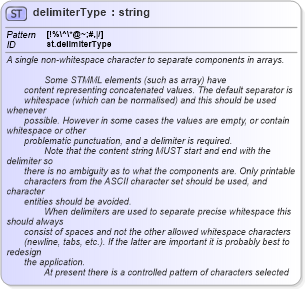
            <h:div class="summary" xmlns:h="http://www.w3.org/1999/xhtml">A single non-whitespace character to separate components in arrays.</h:div>
            <h:div class="description" xmlns:h="http://www.w3.org/1999/xhtml">
                <h:p>Some STMML elements (such as <h:a href="el.array">array</h:a>) have
        content representing concatenated values. The default separator is
        whitespace (which can be normalised) and this should be used whenever
        possible. However in some cases the values are empty, or contain whitespace or other
        problematic punctuation, and a delimiter is required.</h:p>
                <h:p>Note that the content string MUST start and end with the delimiter so
        there is no ambiguity as to what the components are. Only printable
        characters from the ASCII character set should be used, and character
        entities should be avoided.</h:p>
                <h:p>When delimiters are used to separate precise whitespace this should always
        consist of spaces and not the other allowed whitespace characters
        (newline, tabs, etc.). If the latter are important it is probably best to redesign
        the application.</h:p>
                <h:p>At present there is a controlled pattern of characters selected so as not to collide with common usage in XML document</h:p>
            </h:div>
            <h:div class="example" href="delimiterType1.xml" xmlns:h="http://www.w3.org/1999/xhtml">
                <h:em>The values in the array are</h:em>
  "A", "B12", "" (empty string) and "D and   E"
 <h:em>note the spaces</h:em>
            </h:div>
        </xsd:documentation>
    </xsd:annotation>
    <xsd:restriction base="xsd:string">
        <!--<xsd:pattern value="[\!\$\%\^\*\@\~\;\#\,/\|]"/>-->
        <xsd:pattern value="[!%\^\*@~;#,|/]" />
    </xsd:restriction>
</xsd:simpleType>
|
 XSD Schema Diagram:
 Facets: