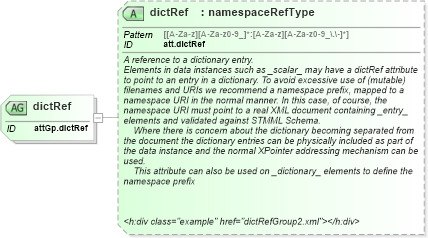
<xsd:attributeGroup name="dictRef" id="attGp.dictRef">
    <xsd:attribute id="att.dictRef" name="dictRef" type="namespaceRefType">
        <xsd:annotation>
            <xsd:documentation>
                <h:div class="summary" xmlns:h="http://www.w3.org/1999/xhtml">A reference to a dictionary entry.</h:div>
                <h:div class="description" xmlns:h="http://www.w3.org/1999/xhtml">Elements in data instances such as _scalar_ may have a <h:tt>dictRef</h:tt> attribute to point to an entry in a dictionary. To avoid excessive use of (mutable) filenames and URIs we recommend a namespace prefix, mapped to a namespace URI in the normal manner. In this case, of course, the namespace URI must point to a real XML document containing _entry_ elements and validated against STMML Schema.
                    <h:p>Where there is concern about the dictionary becoming separated from the document the dictionary entries can be physically included as part of the data instance and the normal XPointer addressing mechanism can be used.</h:p>
                    <h:p>This attribute can also be used on _dictionary_ elements to define the namespace prefix</h:p>
                </h:div>
                <h:div class="example" href="dictRefGroup1.xml" xmlns:h="http://www.w3.org/1999/xhtml" />
                <!--
                <h:div class="example" href="dictRefGroup2.xml"></h:div>
-->
            </xsd:documentation>
        </xsd:annotation>
    </xsd:attribute>
</xsd:attributeGroup>
|
 XSD Schema Diagram: