<xsd:simpleType name="metadataType" id="st.metadataType">
    <xsd:annotation>
        <xsd:documentation>
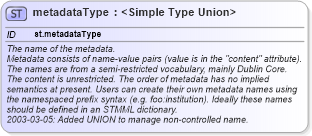
            <h:div class="summary" xmlns:h="http://www.w3.org/1999/xhtml">The name of the metadata.</h:div>
            <h:div class="description" xmlns:h="http://www.w3.org/1999/xhtml">Metadata consists of name-value pairs (value is in the "content" attribute). The names are from a semi-restricted vocabulary, mainly Dublin Core. The content is unrestricted. The order of metadata has no implied semantics at present. Users can create their own metadata names using the namespaced prefix syntax (e.g. foo:institution). Ideally these names should be defined in an STMML dictionary.</h:div>
            <h:div class="curation" xmlns:h="http://www.w3.org/1999/xhtml">2003-03-05: Added UNION to manage non-controlled name.</h:div>
        </xsd:documentation>
    </xsd:annotation>
    <xsd:union>
        <xsd:simpleType>
            <xsd:restriction base="xsd:string">
                <xsd:enumeration value="dc:coverage">
                    <xsd:annotation>
                        <xsd:documentation>
                            <h:div class="definition" xmlns:h="http://www.w3.org/1999/xhtml">The extent or scope of the
            content of the resource.</h:div>
                            <h:div class="description" xmlns:h="http://www.w3.org/1999/xhtml">Coverage will typically include
            spatial location (a place name or geographic
            coordinates), temporal period (a period label, date, or
            date range) or jurisdiction (such as a named
            administrative entity). Recommended best practice is to
            select a value from a controlled vocabulary (for
            example, the Thesaurus of Geographic Names [TGN]) and
            that, where appropriate, named places or time periods
            be used in preference to numeric identifiers such as
            sets of coordinates or date ranges.</h:div>
                        </xsd:documentation>
                    </xsd:annotation>
                </xsd:enumeration>
                <xsd:enumeration value="dc:description">
                    <xsd:annotation>
                        <xsd:documentation>
                            <h:div class="definition" xmlns:h="http://www.w3.org/1999/xhtml">An account of the content of the
            resource.</h:div>
                            <h:div class="description" xmlns:h="http://www.w3.org/1999/xhtml">Description may include but is not
            limited to: an abstract, table of contents, reference
            to a graphical representation of content or a free-text
            account of the content.</h:div>
                        </xsd:documentation>
                    </xsd:annotation>
                </xsd:enumeration>
                <xsd:enumeration value="dc:identifier">
                    <xsd:annotation>
                        <xsd:documentation>
                            <h:div class="definition" xmlns:h="http://www.w3.org/1999/xhtml">An unambiguous reference to the
            resource within a given context.</h:div>
                            <h:div class="description" xmlns:h="http://www.w3.org/1999/xhtml">Recommended best practice is to
            identify the resource by means of a string or number
            conforming to a formal identification system. Example
            formal identification systems include the Uniform
            Resource Identifier (URI) (including the Uniform
            Resource Locator (URL)), the Digital Object Identifier
            (DOI) and the International Standard Book Number
            (ISBN).</h:div>
                        </xsd:documentation>
                    </xsd:annotation>
                </xsd:enumeration>
                <xsd:enumeration value="dc:format">
                    <xsd:annotation>
                        <xsd:documentation>
                            <h:div class="definition" xmlns:h="http://www.w3.org/1999/xhtml">The physical or digital
            manifestation of the resource.</h:div>
                            <h:div class="description" xmlns:h="http://www.w3.org/1999/xhtml">Typically, Format may include the
            media-type or dimensions of the resource. Format may be
            used to determine the software, hardware or other
            equipment needed to display or operate the resource.
            Examples of dimensions include size and duration.
            Recommended best practice is to select a value from a
            controlled vocabulary (for example, the list of
            Internet Media Types [MIME] defining computer media
            formats).</h:div>
                        </xsd:documentation>
                    </xsd:annotation>
                </xsd:enumeration>
                <xsd:enumeration value="dc:relation">
                    <xsd:annotation>
                        <xsd:documentation>
                            <h:div class="definition" xmlns:h="http://www.w3.org/1999/xhtml">A reference to a related
            resource.</h:div>
                            <h:div class="description" xmlns:h="http://www.w3.org/1999/xhtml">Recommended best practice is to
            reference the resource by means of a string or number
            conforming to a formal identification system.</h:div>
                        </xsd:documentation>
                    </xsd:annotation>
                </xsd:enumeration>
                <xsd:enumeration value="dc:rights">
                    <xsd:annotation>
                        <xsd:documentation>
                            <h:div class="definition" xmlns:h="http://www.w3.org/1999/xhtml">Information about rights held in
            and over the resource.</h:div>
                            <h:div class="description" xmlns:h="http://www.w3.org/1999/xhtml">Typically, a Rights element will
            contain a rights management statement for the resource,
            or reference a service providing such information.
            Rights information often encompasses Intellectual
            Property Rights (IPR), Copyright, and various Property
            Rights. If the Rights element is absent, no assumptions
            can be made about the status of these and other rights
            with respect to the resource.</h:div>
                        </xsd:documentation>
                    </xsd:annotation>
                </xsd:enumeration>
                <xsd:enumeration value="dc:subject">
                    <xsd:annotation>
                        <xsd:documentation>
                            <h:div class="definition" xmlns:h="http://www.w3.org/1999/xhtml">The topic of the content of the
            resource.</h:div>
                            <h:div class="description" xmlns:h="http://www.w3.org/1999/xhtml">Typically, a Subject will be
            expressed as keywords, key phrases or classification
            codes that describe a topic of the resource.
            Recommended best practice is to select a value from a
            controlled vocabulary or formal classification
            scheme.</h:div>
                        </xsd:documentation>
                    </xsd:annotation>
                </xsd:enumeration>
                <xsd:enumeration value="dc:title">
                    <xsd:annotation>
                        <xsd:documentation>
                            <h:div class="definition" xmlns:h="http://www.w3.org/1999/xhtml">A name given to the resource.</h:div>
                            <h:div class="description" xmlns:h="http://www.w3.org/1999/xhtml">Typically, a Title will be a name by
            which the resource is formally known.</h:div>
                        </xsd:documentation>
                    </xsd:annotation>
                </xsd:enumeration>
                <xsd:enumeration value="dc:type">
                    <xsd:annotation>
                        <xsd:documentation>
                            <h:div class="definition" xmlns:h="http://www.w3.org/1999/xhtml">The nature or genre of the
            content of the resource.</h:div>
                            <h:div class="description" xmlns:h="http://www.w3.org/1999/xhtml">Type includes terms describing
            general categories, functions, genres, or aggregation
            levels for content. Recommended best practice is to
            select a value from a controlled vocabulary (for
            example, the working draft list of Dublin Core Types
            [DCT1]). To describe the physical or digital
            manifestation of the resource, use the FORMAT
            element.</h:div>
                        </xsd:documentation>
                    </xsd:annotation>
                </xsd:enumeration>
                <xsd:enumeration value="dc:contributor">
                    <xsd:annotation>
                        <xsd:documentation>
                            <h:div class="definition" xmlns:h="http://www.w3.org/1999/xhtml">An entity responsible for making
            contributions to the content of the resource.</h:div>
                            <h:div class="description" xmlns:h="http://www.w3.org/1999/xhtml">Examples of a Contributor include a
            person, an organisation, or a service. Typically, the
            name of a Contributor should be used to indicate the
            entity.</h:div>
                        </xsd:documentation>
                    </xsd:annotation>
                </xsd:enumeration>
                <xsd:enumeration value="dc:creator">
                    <xsd:annotation>
                        <xsd:documentation>
                            <h:div class="definition" xmlns:h="http://www.w3.org/1999/xhtml">An entity primarily responsible
            for making the content of the resource.</h:div>
                            <h:div class="description" xmlns:h="http://www.w3.org/1999/xhtml">Examples of a Creator include a
            person, an organisation, or a service. Typically, the
            name of a Creator should be used to indicate the
            entity.</h:div>
                        </xsd:documentation>
                    </xsd:annotation>
                </xsd:enumeration>
                <xsd:enumeration value="dc:publisher">
                    <xsd:annotation>
                        <xsd:documentation>
                            <h:div class="definition" xmlns:h="http://www.w3.org/1999/xhtml">An entity responsible for making
            the resource available.</h:div>
                            <h:div class="description" xmlns:h="http://www.w3.org/1999/xhtml">Examples of a Publisher include a
            person, an organisation, or a service. Typically, the
            name of a Publisher should be used to indicate the
            entity.</h:div>
                        </xsd:documentation>
                    </xsd:annotation>
                </xsd:enumeration>
                <xsd:enumeration value="dc:source">
                    <xsd:annotation>
                        <xsd:documentation>
                            <h:div class="definition" xmlns:h="http://www.w3.org/1999/xhtml">A Reference to a resource from
            which the present resource is derived.</h:div>
                            <h:div class="description" xmlns:h="http://www.w3.org/1999/xhtml">The present resource may be derived
            from the Source resource in whole or in part.
            Recommended best practice is to reference the resource
            by means of a string or number conforming to a formal
            identification system.</h:div>
                        </xsd:documentation>
                    </xsd:annotation>
                </xsd:enumeration>
                <xsd:enumeration value="dc:language">
                    <xsd:annotation>
                        <xsd:documentation>
                            <h:div class="definition" xmlns:h="http://www.w3.org/1999/xhtml">A language of the intellectual
            content of the resource.</h:div>
                            <h:div class="description" xmlns:h="http://www.w3.org/1999/xhtml">Recommended best practice for the
            values of the Language element is defined by RFC 1766
            [RFC1766] which includes a two-letter Language Code
            (taken from the ISO 639 standard [ISO639]), followed
            optionally, by a two-letter Country Code (taken from
            the ISO 3166 standard [ISO3166]). For example, 'en' for
            English, 'fr' for French, or 'en-uk' for English used
            in the United Kingdom.</h:div>
                        </xsd:documentation>
                    </xsd:annotation>
                </xsd:enumeration>
                <xsd:enumeration value="dc:date">
                    <xsd:annotation>
                        <xsd:documentation>
                            <h:div class="definition" xmlns:h="http://www.w3.org/1999/xhtml">A date associated with an event
            in the life cycle of the resource.</h:div>
                            <h:div class="description" xmlns:h="http://www.w3.org/1999/xhtml">Typically, Date will be associated
            with the creation or availability of the resource.
            Recommended best practice for encoding the date value
            is defined in a profile of ISO 8601 [W3CDTF] and
            follows the YYYY-MM-DD format.</h:div>
                        </xsd:documentation>
                    </xsd:annotation>
                </xsd:enumeration>
                <xsd:enumeration value="cmlm:safety">
                    <xsd:annotation>
                        <xsd:documentation>
                            <h:div class="definition" xmlns:h="http://www.w3.org/1999/xhtml">Entry contains information
            relating to chemical safety.</h:div>
                            <h:div class="description" xmlns:h="http://www.w3.org/1999/xhtml">Typically the content will be a
            reference to a handbook, MSDS, threshhold or other
            human-readable strin.</h:div>
                        </xsd:documentation>
                    </xsd:annotation>
                </xsd:enumeration>
                <xsd:enumeration value="cmlm:insilico">
                    <xsd:annotation>
                        <xsd:documentation>
                            <h:div class="definition" xmlns:h="http://www.w3.org/1999/xhtml">Part or whole of the information
            was computer-generated.</h:div>
                            <h:div class="description" xmlns:h="http://www.w3.org/1999/xhtml">Typically the content will be the
            name of a method or a progra.</h:div>
                        </xsd:documentation>
                    </xsd:annotation>
                </xsd:enumeration>
                <xsd:enumeration value="cmlm:structure">
                    <xsd:annotation>
                        <xsd:documentation>
                            <h:div class="definition" xmlns:h="http://www.w3.org/1999/xhtml">3D structure included.</h:div>
                            <h:div class="description" xmlns:h="http://www.w3.org/1999/xhtml">details include.</h:div>
                        </xsd:documentation>
                    </xsd:annotation>
                </xsd:enumeration>
                <xsd:enumeration value="cmlm:reaction" />
                <xsd:enumeration value="cmlm:identifier" />
                <xsd:enumeration value="other" />
            </xsd:restriction>
        </xsd:simpleType>
        <xsd:simpleType>
            <xsd:restriction base="namespaceRefType" />
        </xsd:simpleType>
    </xsd:union>
</xsd:simpleType>
|
 XSD Schema Diagram: