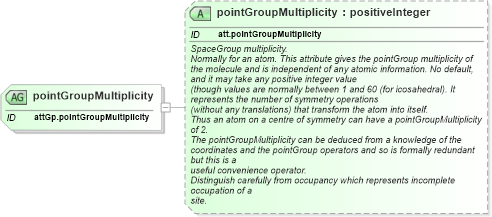
<xsd:attributeGroup id="attGp.pointGroupMultiplicity" name="pointGroupMultiplicity">
    <xsd:attribute id="att.pointGroupMultiplicity" name="pointGroupMultiplicity" type="xsd:positiveInteger">
        <xsd:annotation>
            <xsd:documentation>
                <h:div class="summary" xmlns:h="http://www.w3.org/1999/xhtml">SpaceGroup multiplicity.</h:div>
                <h:div class="description" xmlns:h="http://www.w3.org/1999/xhtml">Normally for an atom. This attribute gives the pointGroup multiplicity of the molecule and is independent of any atomic information. No default, and it may take any positive integer value
                (though values are normally between 1 and 60 (for icosahedral). It represents the number of symmetry operations
                (without any translations) that transform the atom into itself.
                Thus an atom on a centre of symmetry can have a pointGroupMultiplicity of 2.
                The pointGroupMultiplicity can be deduced from a knowledge of the
                coordinates and the pointGroup operators and so is formally redundant but this is a
                useful convenience operator.
                Distinguish carefully from occupancy which represents incomplete occupation of a
                site.</h:div>
            </xsd:documentation>
        </xsd:annotation>
    </xsd:attribute>
</xsd:attributeGroup>
|
 XSD Schema Diagram: