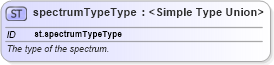
<xsd:simpleType id="st.spectrumTypeType" name="spectrumTypeType">
    <xsd:annotation>
        <xsd:documentation>
            <h:div class="summary" xmlns:h="http://www.w3.org/1999/xhtml">The type of the spectrum.</h:div>
        </xsd:documentation>
    </xsd:annotation>
    <xsd:union>
        <xsd:simpleType>
            <xsd:restriction base="xsd:string">
                <xsd:enumeration value="infrared">
                    <xsd:annotation>
                        <xsd:documentation>
                            <h:div class="summary" xmlns:h="http://www.w3.org/1999/xhtml">An infrared spectrum.</h:div>
                            <h:div class="description" xmlns:h="http://www.w3.org/1999/xhtml">The measurement should denote transmittance or absorbanc.</h:div>
                        </xsd:documentation>
                    </xsd:annotation>
                </xsd:enumeration>
                <xsd:enumeration value="massSpectrum">
                    <xsd:annotation>
                        <xsd:documentation>
                            <h:div class="summary" xmlns:h="http://www.w3.org/1999/xhtml">A "simple" mass spectrum.</h:div>
                            <h:div class="description" xmlns:h="http://www.w3.org/1999/xhtml">This excludes experiments such as GC/MS, MS/MS, etc. though these could be constructed out of individual spectra with some care. The spectrum may be continuous ( <h:tt>data</h:tt> or a <h:tt>peakList</h:tt>).</h:div>
                        </xsd:documentation>
                    </xsd:annotation>
                </xsd:enumeration>
                <xsd:enumeration value="NMR">
                    <xsd:annotation>
                        <xsd:documentation>
                            <h:div class="summary" xmlns:h="http://www.w3.org/1999/xhtml">An NMR spectrum.</h:div>
                            <h:div class="description" xmlns:h="http://www.w3.org/1999/xhtml">This can include any experiment which creates a "1D"  or "2D" data array. The symmetry of the spectrum can be specified but the details of the NMR experiment (COSY, NOESY, etc.) are not part of CMLSpect. They can be described though the normal <h:tt>dictRef</h:tt> mechanism.</h:div>
                        </xsd:documentation>
                    </xsd:annotation>
                </xsd:enumeration>
                <xsd:enumeration value="UV/VIS">
                    <xsd:annotation>
                        <xsd:documentation>
                            <h:div class="summary" xmlns:h="http://www.w3.org/1999/xhtml">A spectrum somewhere in the UV VIS region of the spectrum.</h:div>
                            <h:div class="description" xmlns:h="http://www.w3.org/1999/xhtml">The measurement should denote transmittance or absorbance.</h:div>
                        </xsd:documentation>
                    </xsd:annotation>
                </xsd:enumeration>
            </xsd:restriction>
        </xsd:simpleType>
        <xsd:simpleType>
            <xsd:restriction base="namespaceRefType" />
        </xsd:simpleType>
    </xsd:union>
</xsd:simpleType>
|
 XSD Schema Diagram: