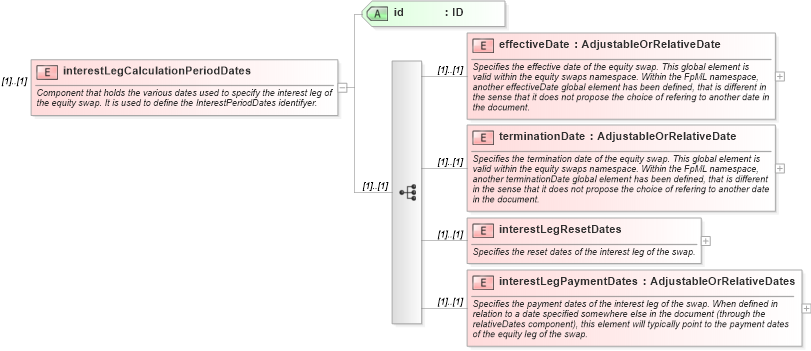
<xsd:element name="interestLegCalculationPeriodDates">
    <xsd:annotation>
        <xsd:documentation xml:lang="en">Component that holds the various dates used to specify the interest leg of the equity swap. It is used to define the InterestPeriodDates identifyer.</xsd:documentation>
    </xsd:annotation>
    <xsd:complexType>
        <xsd:sequence>
            <xsd:element name="effectiveDate" type="AdjustableOrRelativeDate">
                <xsd:annotation>
                    <xsd:documentation xml:lang="en">Specifies the effective date of the equity swap. This global element is valid within the equity swaps namespace. Within the FpML namespace, another effectiveDate global element has been defined, that is different in the sense that it does not propose the choice of refering to another date in the document.</xsd:documentation>
                </xsd:annotation>
            </xsd:element>
            <xsd:element name="terminationDate" type="AdjustableOrRelativeDate">
                <xsd:annotation>
                    <xsd:documentation xml:lang="en">Specifies the termination date of the equity swap. This global element is valid within the equity swaps namespace. Within the FpML namespace, another terminationDate global element has been defined, that is different in the sense that it does not propose the choice of refering to another date in the document.</xsd:documentation>
                </xsd:annotation>
            </xsd:element>
            <xsd:element name="interestLegResetDates">
                <xsd:annotation>
                    <xsd:documentation xml:lang="en">Specifies the reset dates of the interest leg of the swap.</xsd:documentation>
                </xsd:annotation>
                <xsd:complexType>
                    <xsd:sequence>
                        <xsd:element name="calculationPeriodDatesReference">
                            <xsd:annotation>
                                <xsd:documentation xml:lang="en">A pointer style reference to the associated calculation period dates component defined elsewhere in the document.</xsd:documentation>
                            </xsd:annotation>
                            <xsd:complexType>
                                <xsd:attribute name="href" type="xsd:IDREF" use="required" />
                            </xsd:complexType>
                        </xsd:element>
                        <xsd:choice>
                            <xsd:element name="resetRelativeTo" type="ResetRelativeToEnum">
                                <xsd:annotation>
                                    <xsd:documentation xml:lang="en">Specifies whether the reset dates are determined with respect to each adjusted calculation period start date or adjusted calculation period end date. If the reset frequency is specified as daily this element must not be included.</xsd:documentation>
                                </xsd:annotation>
                            </xsd:element>
                            <xsd:element name="resetFrequency" type="ResetFrequency">
                                <xsd:annotation>
                                    <xsd:documentation xml:lang="en">The frequency at which reset dates occur. In the case of a weekly reset frequency, also specifies the day of the week that the reset occurs. If the reset frequency is greater than the calculation period frequency then this implies that more than one reset date is established for each calculation period and some form of rate averaging is applicable.</xsd:documentation>
                                </xsd:annotation>
                            </xsd:element>
                        </xsd:choice>
                    </xsd:sequence>
                </xsd:complexType>
            </xsd:element>
            <xsd:element name="interestLegPaymentDates" type="AdjustableOrRelativeDates">
                <xsd:annotation>
                    <xsd:documentation xml:lang="en">Specifies the payment dates of the interest leg of the swap. When defined in relation to a date specified somewhere else in the document (through the relativeDates component), this element will typically point to the payment dates of the equity leg of the swap.</xsd:documentation>
                </xsd:annotation>
            </xsd:element>
        </xsd:sequence>
        <xsd:attribute name="id" type="xsd:ID" use="required" />
    </xsd:complexType>
</xsd:element>
|
 XSD Schema Diagram: