Definition Type: Element
Name: beneficiary
Namespace: http://www.fpml.org/FpML-5/reporting
Type: nsE:Beneficiary
Containing Schema: fpml-shared-5-10.xsd
MinOccurs 0
MaxOccurs (1)
Abstract
Documentation:
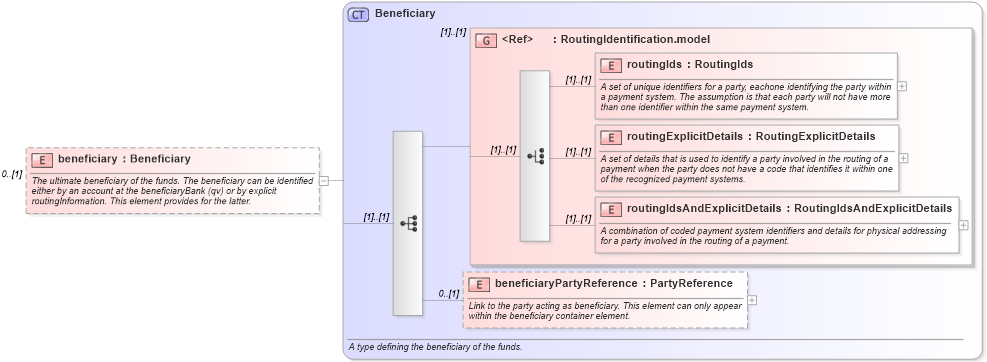
The ultimate beneficiary of the funds. The beneficiary can be identified either by an account at the beneficiaryBank (qv) or by explicit routingInformation. This element provides for the latter.
Collapse XSD Schema Diagram:
Drilldown into beneficiaryPartyReference in schema fpml-shared-5-10_xsd4 Drilldown into routingIdsAndExplicitDetails in schema fpml-shared-5-10_xsd4 Drilldown into routingExplicitDetails in schema fpml-shared-5-10_xsd4 Drilldown into routingIds in schema fpml-shared-5-10_xsd4 Drilldown into RoutingIdentification.model in schema fpml-shared-5-10_xsd4 Drilldown into Beneficiary in schema fpml-shared-5-10_xsd4XSD Diagram of beneficiary in schema fpml-shared-5-10_xsd4 (Financial products Markup Language (FpML®))
Collapse XSD Schema Code:
<xsd:element name="beneficiary" type="Beneficiary" minOccurs="0">
    <xsd:annotation>
        <xsd:documentation xml:lang="en">The ultimate beneficiary of the funds. The beneficiary can be identified either by an account at the beneficiaryBank (qv) or by explicit routingInformation. This element provides for the latter.</xsd:documentation>
    </xsd:annotation>
</xsd:element>
Collapse Child Elements:
Name Type Min Occurs Max Occurs
routingIds nsE:routingIds (1) (1)
routingExplicitDetails nsE:routingExplicitDetails (1) (1)
routingIdsAndExplicitDetails nsE:routingIdsAndExplicitDetails (1) (1)
beneficiaryPartyReference nsE:beneficiaryPartyReference 0 (1)
<xs:group> nsE:RoutingIdentification.model (1) (1)
Collapse Derivation Tree: