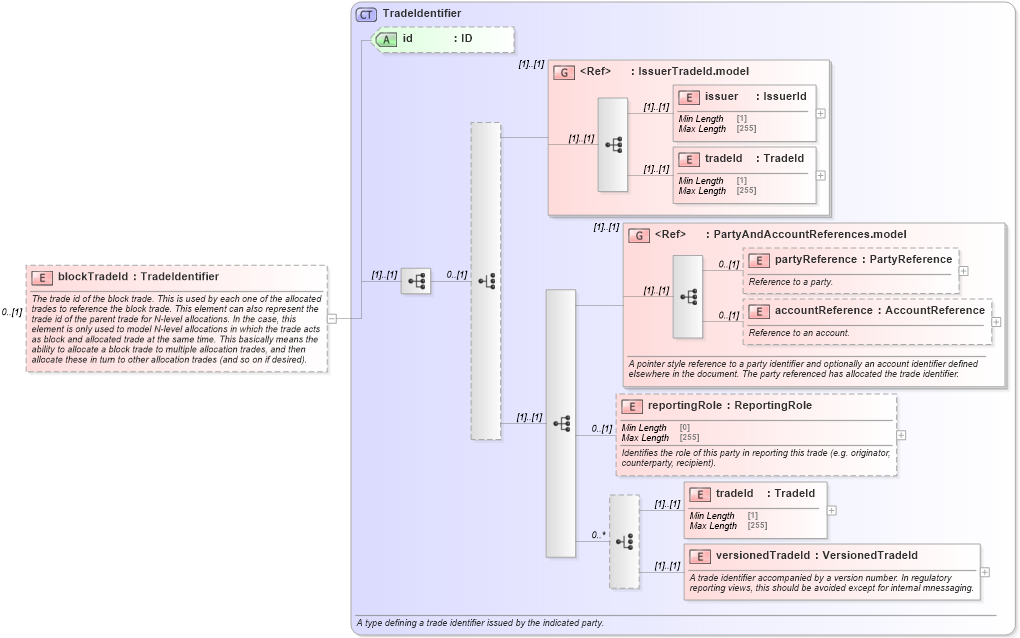
Definition Type: Element
Name: blockTradeId
Namespace: http://www.fpml.org/FpML-5/reporting
Type: nsE:TradeIdentifier
Containing Schema: fpml-doc-5-10.xsd
MinOccurs 0
MaxOccurs (1)
Abstract
Documentation:
The trade id of the block trade. This is used by each one of the allocated trades to reference the block trade. This element can also represent the trade id of the parent trade for N-level allocations. In the case, this element is only used to model N-level allocations in which the trade acts as block and allocated trade at the same time. This basically means the ability to allocate a block trade to multiple allocation trades, and then allocate these in turn to other allocation trades (and so on if desired).
Collapse XSD Schema Diagram:
Drilldown into versionedTradeId in schema fpml-doc-5-10_xsd4 Drilldown into tradeId in schema fpml-doc-5-10_xsd4 Drilldown into reportingRole in schema fpml-doc-5-10_xsd4 Drilldown into accountReference in schema fpml-shared-5-10_xsd4 Drilldown into partyReference in schema fpml-shared-5-10_xsd4 Drilldown into PartyAndAccountReferences.model in schema fpml-shared-5-10_xsd4 Drilldown into tradeId in schema fpml-shared-5-10_xsd4 Drilldown into issuer in schema fpml-shared-5-10_xsd4 Drilldown into IssuerTradeId.model in schema fpml-shared-5-10_xsd4 Drilldown into id in schema fpml-doc-5-10_xsd4 Drilldown into TradeIdentifier in schema fpml-doc-5-10_xsd4XSD Diagram of blockTradeId in schema fpml-doc-5-10_xsd4 (Financial products Markup Language (FpML®))
Collapse XSD Schema Code:
<xsd:element name="blockTradeId" type="TradeIdentifier" minOccurs="0">
    <xsd:annotation>
        <xsd:documentation xml:lang="en">The trade id of the block trade. This is used by each one of the allocated trades to reference the block trade. This element can also represent the trade id of the parent trade for N-level allocations. In the case, this element is only used to model N-level allocations in which the trade acts as block and allocated trade at the same time. This basically means the ability to allocate a block trade to multiple allocation trades, and then allocate these in turn to other allocation trades (and so on if desired).</xsd:documentation>
    </xsd:annotation>
</xsd:element>
Collapse Child Elements:
Name Type Min Occurs Max Occurs
issuer nsE:issuer (1) (1)
tradeId nsE:tradeId (1) (1)
partyReference nsE:partyReference 0 (1)
accountReference nsE:accountReference 0 (1)
reportingRole nsE:reportingRole 0 (1)
tradeId nsE:tradeId (1) (1)
versionedTradeId nsE:versionedTradeId (1) (1)
<xs:group> nsE:IssuerTradeId.model (1) (1)
<xs:group> nsE:PartyAndAccountReferences.model (1) (1)
Collapse Child Attributes:
Name Type Default Value Use
id nsE:id (Optional)
Collapse Derivation Tree: