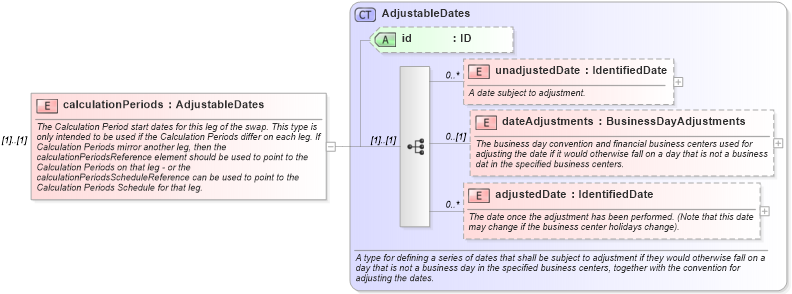
Definition Type: Element
Name: calculationPeriods
Namespace: http://www.fpml.org/FpML-5/reporting
Type: nsE:AdjustableDates
Containing Schema: fpml-com-5-10.xsd
MinOccurs (1)
MaxOccurs (1)
Abstract
Documentation:
The Calculation Period start dates for this leg of the swap. This type is only intended to be used if the Calculation Periods differ on each leg. If Calculation Periods mirror another leg, then the calculationPeriodsReference element should be used to point to the Calculation Periods on that leg - or the calculationPeriodsScheduleReference can be used to point to the Calculation Periods Schedule for that leg.
Collapse XSD Schema Diagram:
Drilldown into adjustedDate in schema fpml-shared-5-10_xsd4 Drilldown into dateAdjustments in schema fpml-shared-5-10_xsd4 Drilldown into unadjustedDate in schema fpml-shared-5-10_xsd4 Drilldown into id in schema fpml-shared-5-10_xsd4 Drilldown into AdjustableDates in schema fpml-shared-5-10_xsd4XSD Diagram of calculationPeriods in schema fpml-com-5-10_xsd2 (Financial products Markup Language (FpML®))
Collapse XSD Schema Code:
<xsd:element name="calculationPeriods" type="AdjustableDates">
    <xsd:annotation>
        <xsd:documentation xml:lang="en">The Calculation Period start dates for this leg of the swap. This type is only intended to be used if the Calculation Periods differ on each leg. If Calculation Periods mirror another leg, then the calculationPeriodsReference element should be used to point to the Calculation Periods on that leg - or the calculationPeriodsScheduleReference can be used to point to the Calculation Periods Schedule for that leg.</xsd:documentation>
    </xsd:annotation>
</xsd:element>
Collapse Child Elements:
Name Type Min Occurs Max Occurs
unadjustedDate nsE:unadjustedDate 0 unbounded
dateAdjustments nsE:dateAdjustments 0 (1)
adjustedDate nsE:adjustedDate 0 unbounded
Collapse Child Attributes:
Name Type Default Value Use
id nsE:id Optional
Collapse Derivation Tree: