Definition Type: Element
Name: capRateSchedule
Namespace: http://www.fpml.org/FpML-5/recordkeeping
Type: nsD:StrikeSchedule
Containing Schema: fpml-shared-5-10.xsd
MinOccurs 0
MaxOccurs unbounded
Abstract
Documentation:
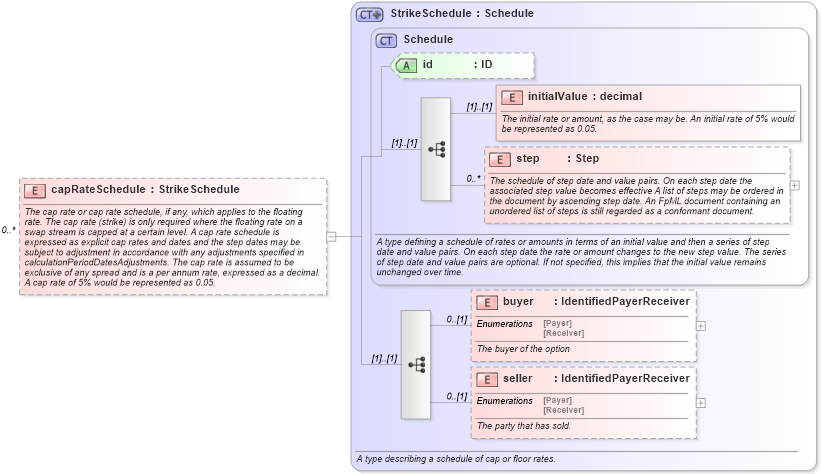
The cap rate or cap rate schedule, if any, which applies to the floating rate. The cap rate (strike) is only required where the floating rate on a swap stream is capped at a certain level. A cap rate schedule is expressed as explicit cap rates and dates and the step dates may be subject to adjustment in accordance with any adjustments specified in calculationPeriodDatesAdjustments. The cap rate is assumed to be exclusive of any spread and is a per annum rate, expressed as a decimal. A cap rate of 5% would be represented as 0.05.
Collapse XSD Schema Diagram:
Drilldown into seller in schema fpml-shared-5-10_xsd3 Drilldown into buyer in schema fpml-shared-5-10_xsd3 Drilldown into step in schema fpml-shared-5-10_xsd3 Drilldown into initialValue in schema fpml-shared-5-10_xsd3 Drilldown into id in schema fpml-shared-5-10_xsd3 Drilldown into Schedule in schema fpml-shared-5-10_xsd3 Drilldown into StrikeSchedule in schema fpml-shared-5-10_xsd3XSD Diagram of capRateSchedule in schema fpml-shared-5-10_xsd3 (Financial products Markup Language (FpML®))
Collapse XSD Schema Code:
<xsd:element name="capRateSchedule" type="StrikeSchedule" minOccurs="0" maxOccurs="unbounded">
    <xsd:annotation>
        <xsd:documentation xml:lang="en">The cap rate or cap rate schedule, if any, which applies to the floating rate. The cap rate (strike) is only required where the floating rate on a swap stream is capped at a certain level. A cap rate schedule is expressed as explicit cap rates and dates and the step dates may be subject to adjustment in accordance with any adjustments specified in calculationPeriodDatesAdjustments. The cap rate is assumed to be exclusive of any spread and is a per annum rate, expressed as a decimal. A cap rate of 5% would be represented as 0.05.</xsd:documentation>
    </xsd:annotation>
</xsd:element>
Collapse Child Elements:
Name Type Min Occurs Max Occurs
initialValue nsD:initialValue (1) (1)
step nsD:step 0 unbounded
buyer nsD:buyer 0 (1)
seller nsD:seller 0 (1)
Collapse Child Attributes:
Name Type Default Value Use
id nsD:id (Optional)
Collapse Derivation Tree: