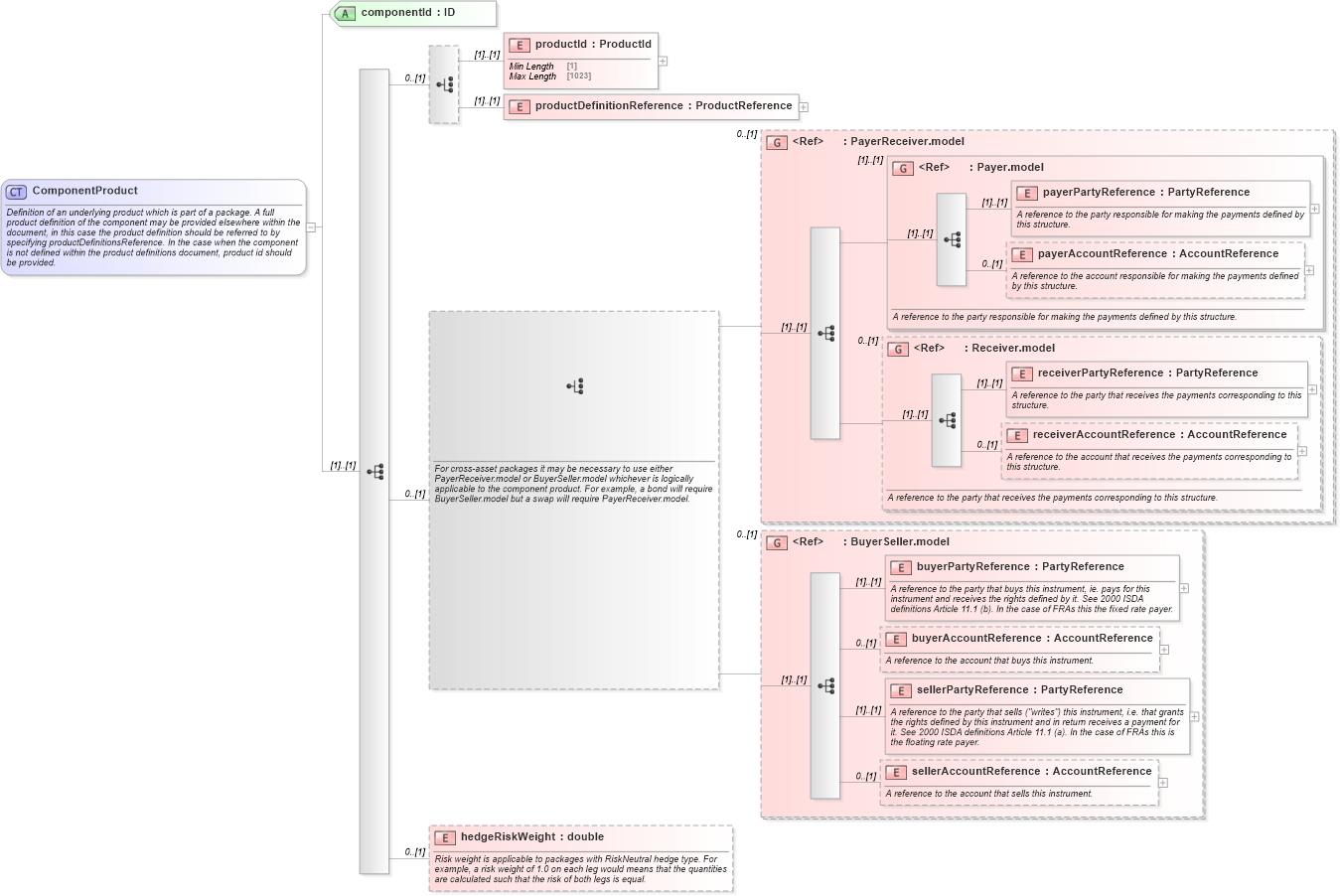
<xsd:complexType name="ComponentProduct">
    <xsd:annotation>
        <xsd:documentation xml:lang="en">Definition of an underlying product which is part of a package. A full product definition of the component may be provided elsewhere within the document, in this case the product definition should be referred to by specifying productDefinitionsReference. In the case when the component is not defined within the product definitions document, product id should be provided.</xsd:documentation>
    </xsd:annotation>
    <xsd:sequence>
        <xsd:choice minOccurs="0">
            <xsd:element name="productId" type="ProductId" />
            <xsd:element name="productDefinitionReference" type="ProductReference" />
        </xsd:choice>
        <xsd:choice minOccurs="0">
            <xsd:annotation>
                <xsd:documentation>For cross-asset packages it may be necessary to use either PayerReceiver.model or BuyerSeller.model whichever is logically applicable to the component product. For example, a bond will require BuyerSeller.model but a swap will require PayerReceiver.model.</xsd:documentation>
            </xsd:annotation>
            <xsd:group minOccurs="0" ref="PayerReceiver.model" />
            <xsd:group minOccurs="0" ref="BuyerSeller.model" />
        </xsd:choice>
        <xsd:element name="hedgeRiskWeight" type="xsd:double" minOccurs="0">
            <xsd:annotation>
                <xsd:documentation>Risk weight is applicable to packages with RiskNeutral hedge type. For example, a risk weight of 1.0 on each leg would means that the quantities are calculated such that the risk of both legs is equal.</xsd:documentation>
            </xsd:annotation>
        </xsd:element>
    </xsd:sequence>
    <xsd:attribute name="componentId" type="xsd:ID" use="required" />
</xsd:complexType>
|
 XSD Schema Diagram: