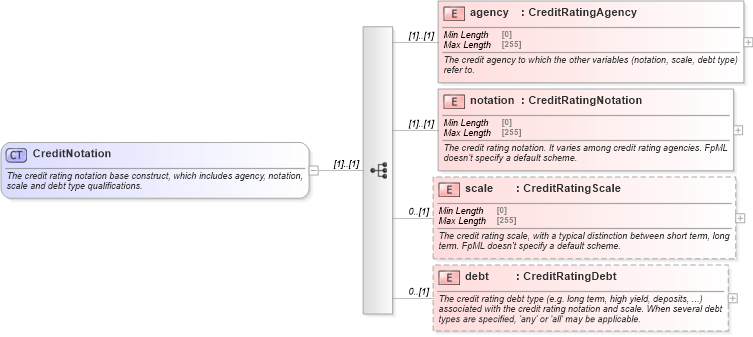
<xsd:complexType name="CreditNotation">
    <xsd:annotation>
        <xsd:documentation xml:lang="en">The credit rating notation base construct, which includes agency, notation, scale and debt type qualifications.</xsd:documentation>
    </xsd:annotation>
    <xsd:sequence>
        <xsd:element name="agency" type="CreditRatingAgency">
            <xsd:annotation>
                <xsd:documentation xml:lang="en">The credit agency to which the other variables (notation, scale, debt type) refer to.</xsd:documentation>
            </xsd:annotation>
        </xsd:element>
        <xsd:element name="notation" type="CreditRatingNotation">
            <xsd:annotation>
                <xsd:documentation xml:lang="en">The credit rating notation. It varies among credit rating agencies. FpML doesn't specify a default scheme.</xsd:documentation>
            </xsd:annotation>
        </xsd:element>
        <xsd:element name="scale" type="CreditRatingScale" minOccurs="0">
            <xsd:annotation>
                <xsd:documentation xml:lang="en">The credit rating scale, with a typical distinction between short term, long term. FpML doesn't specify a default scheme.</xsd:documentation>
            </xsd:annotation>
        </xsd:element>
        <xsd:element name="debt" type="CreditRatingDebt" minOccurs="0">
            <xsd:annotation>
                <xsd:documentation xml:lang="en">The credit rating debt type (e.g. long term, high yield, deposits, ...) associated with the credit rating notation and scale. When several debt types are specified, 'any' or 'all' may be applicable.</xsd:documentation>
            </xsd:annotation>
        </xsd:element>
    </xsd:sequence>
</xsd:complexType>
|
 XSD Schema Diagram: