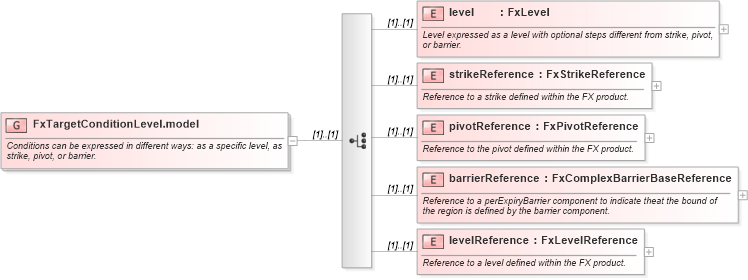
<xsd:group name="FxTargetConditionLevel.model">
    <xsd:annotation>
        <xsd:documentation xml:lang="en">Conditions can be expressed in different ways: as a specific level, as strike, pivot, or barrier.</xsd:documentation>
    </xsd:annotation>
    <xsd:choice>
        <xsd:element name="level" type="FxLevel">
            <xsd:annotation>
                <xsd:documentation xml:lang="en">Level expressed as a level with optional steps different from strike, pivot, or barrier.</xsd:documentation>
            </xsd:annotation>
        </xsd:element>
        <xsd:element name="strikeReference" type="FxStrikeReference">
            <xsd:annotation>
                <xsd:documentation xml:lang="en">Reference to a strike defined within the FX product.</xsd:documentation>
            </xsd:annotation>
        </xsd:element>
        <xsd:element name="pivotReference" type="FxPivotReference">
            <xsd:annotation>
                <xsd:documentation xml:lang="en">Reference to the pivot defined within the FX product.</xsd:documentation>
            </xsd:annotation>
        </xsd:element>
        <xsd:element name="barrierReference" type="FxComplexBarrierBaseReference">
            <xsd:annotation>
                <xsd:documentation xml:lang="en">Reference to a perExpiryBarrier component to indicate theat the bound of the region is defined by the barrier component.</xsd:documentation>
            </xsd:annotation>
        </xsd:element>
        <xsd:element name="levelReference" type="FxLevelReference">
            <xsd:annotation>
                <xsd:documentation xml:lang="en">Reference to a level defined within the FX product.</xsd:documentation>
            </xsd:annotation>
        </xsd:element>
    </xsd:choice>
</xsd:group>
|
 XSD Schema Diagram: