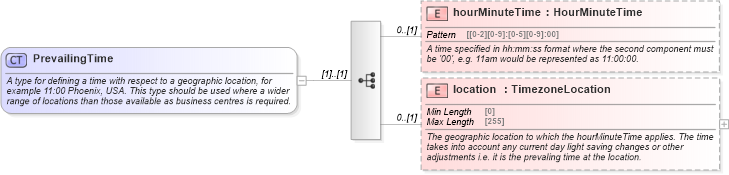
<xsd:complexType name="PrevailingTime">
    <xsd:annotation>
        <xsd:documentation xml:lang="en">A type for defining a time with respect to a geographic location, for example 11:00 Phoenix, USA. This type should be used where a wider range of locations than those available as business centres is required.</xsd:documentation>
    </xsd:annotation>
    <xsd:sequence>
        <xsd:element name="hourMinuteTime" type="HourMinuteTime" minOccurs="0">
            <xsd:annotation>
                <xsd:documentation xml:lang="en">A time specified in hh:mm:ss format where the second component must be '00', e.g. 11am would be represented as 11:00:00.</xsd:documentation>
            </xsd:annotation>
        </xsd:element>
        <xsd:element name="location" type="TimezoneLocation" minOccurs="0">
            <xsd:annotation>
                <xsd:documentation xml:lang="en">The geographic location to which the hourMinuteTime applies. The time takes into account any current day light saving changes or other adjustments i.e. it is the prevaling time at the location.</xsd:documentation>
            </xsd:annotation>
        </xsd:element>
    </xsd:sequence>
</xsd:complexType>
|
 XSD Schema Diagram: