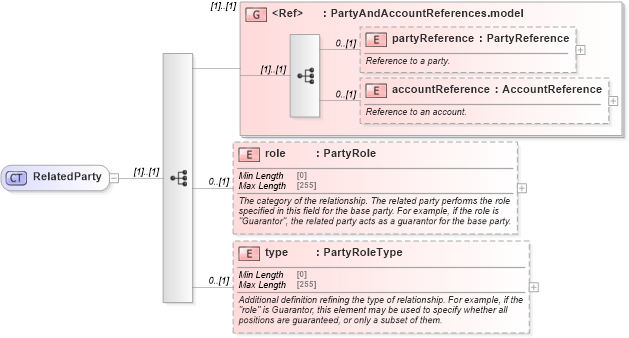
<xsd:complexType name="RelatedParty">
    <xsd:sequence>
        <xsd:group ref="PartyAndAccountReferences.model" />
        <xsd:element name="role" type="PartyRole" minOccurs="0">
            <xsd:annotation>
                <xsd:documentation xml:lang="en">The category of the relationship. The related party performs the role specified in this field for the base party. For example, if the role is "Guarantor", the related party acts as a guarantor for the base party.</xsd:documentation>
            </xsd:annotation>
        </xsd:element>
        <xsd:element name="type" type="PartyRoleType" minOccurs="0">
            <xsd:annotation>
                <xsd:documentation xml:lang="en">Additional definition refining the type of relationship. For example, if the "role" is Guarantor, this element may be used to specify whether all positions are guaranteed, or only a subset of them.</xsd:documentation>
            </xsd:annotation>
        </xsd:element>
    </xsd:sequence>
</xsd:complexType>
|
 XSD Schema Diagram: