Definition Type: Element
Name: relatedParty
Namespace: http://www.fpml.org/FpML-5/transparency
Type: nsF:RelatedParty
Containing Schema: fpml-business-events-5-10.xsd
MinOccurs 0
MaxOccurs unbounded
Abstract
Documentation:
This may be used to identify one or more parties that perform a role within the transaction. If this is within a partyTradeInformation block, the related party performs the role with respect to the party identifie by the "partyReference" in the partyTradeInformation block.
Collapse XSD Schema Diagram:
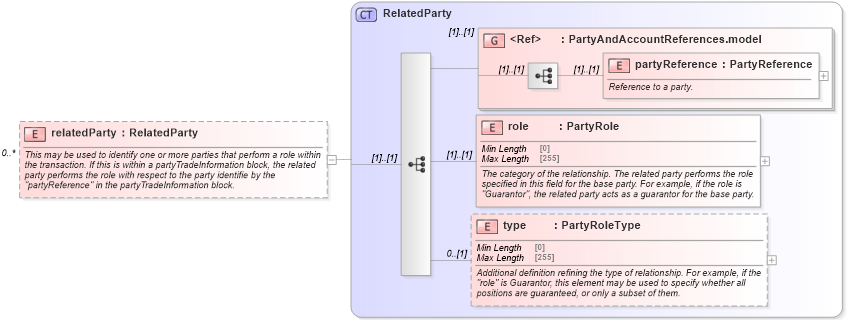
Drilldown into type in schema fpml-shared-5-10_xsd5 Drilldown into role in schema fpml-shared-5-10_xsd5 Drilldown into partyReference in schema fpml-shared-5-10_xsd5 Drilldown into PartyAndAccountReferences.model in schema fpml-shared-5-10_xsd5 Drilldown into RelatedParty in schema fpml-shared-5-10_xsd5XSD Diagram of relatedParty in schema fpml-business-events-5-10_xsd4 (Financial products Markup Language (FpML®))
Collapse XSD Schema Code:
<xsd:element name="relatedParty" type="RelatedParty" minOccurs="0" maxOccurs="unbounded">
    <xsd:annotation>
        <xsd:documentation xml:lang="en">This may be used to identify one or more parties that perform a role within the transaction. If this is within a partyTradeInformation block, the related party performs the role with respect to the party identifie by the "partyReference" in the partyTradeInformation block.</xsd:documentation>
    </xsd:annotation>
</xsd:element>
Collapse Child Elements:
Name Type Min Occurs Max Occurs
partyReference nsF:partyReference (1) (1)
role nsF:role (1) (1)
type nsF:type 0 (1)
<xs:group> nsF:PartyAndAccountReferences.model (1) (1)
Collapse Derivation Tree: