Definition Type: Element
Name: relativeDateSequence
Namespace: http://www.fpml.org/FpML-5/recordkeeping
Type: nsD:RelativeDateSequence
Containing Schema: fpml-eq-shared-5-10.xsd
MinOccurs (1)
MaxOccurs (1)
Abstract
Documentation:
A date specified in relation to some other date defined in the document (the anchor date), where there is the opportunity to specify a combination of offset rules. This component will typically be used for defining the valuation date in relation to the payment date, as both the currency and the exchange holiday calendars need to be considered.
Collapse XSD Schema Diagram:
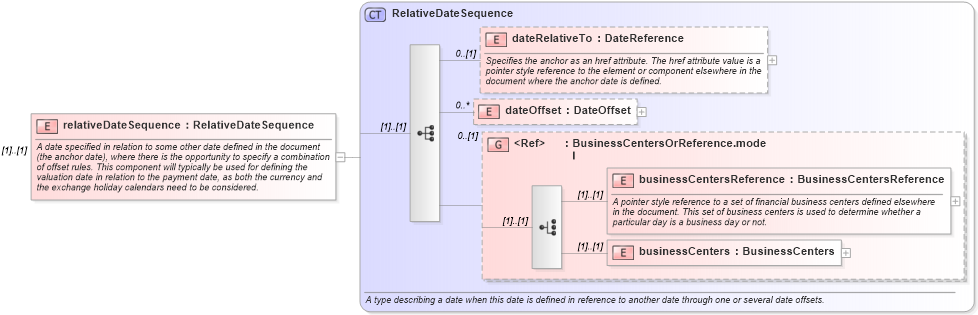
Drilldown into businessCenters in schema fpml-shared-5-10_xsd3 Drilldown into businessCentersReference in schema fpml-shared-5-10_xsd3 Drilldown into BusinessCentersOrReference.model in schema fpml-shared-5-10_xsd3 Drilldown into dateOffset in schema fpml-shared-5-10_xsd3 Drilldown into dateRelativeTo in schema fpml-shared-5-10_xsd3 Drilldown into RelativeDateSequence in schema fpml-shared-5-10_xsd3XSD Diagram of relativeDateSequence in schema fpml-eq-shared-5-10_xsd1 (Financial products Markup Language (FpML®))
Collapse XSD Schema Code:
<xsd:element name="relativeDateSequence" type="RelativeDateSequence">
    <xsd:annotation>
        <xsd:documentation xml:lang="en">A date specified in relation to some other date defined in the document (the anchor date), where there is the opportunity to specify a combination of offset rules. This component will typically be used for defining the valuation date in relation to the payment date, as both the currency and the exchange holiday calendars need to be considered.</xsd:documentation>
    </xsd:annotation>
</xsd:element>
Collapse Child Elements:
Name Type Min Occurs Max Occurs
dateRelativeTo nsD:dateRelativeTo 0 (1)
dateOffset nsD:dateOffset 0 unbounded
businessCentersReference nsD:businessCentersReference (1) (1)
businessCenters nsD:businessCenters (1) (1)
<xs:group> nsD:BusinessCentersOrReference.model 0 (1)
Collapse Derivation Tree: