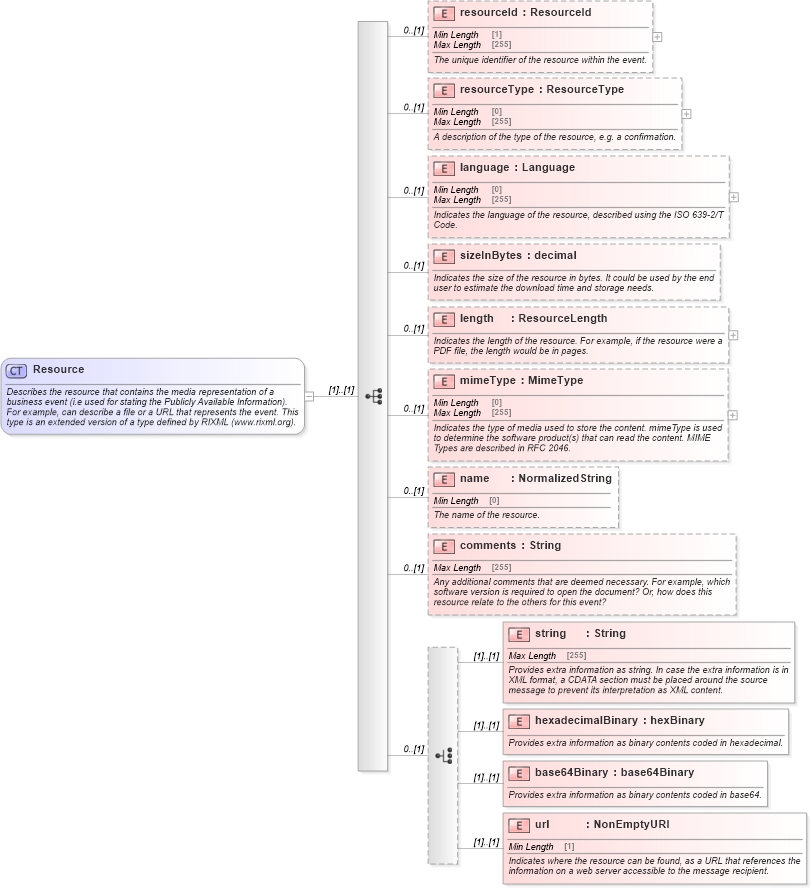
<xsd:complexType name="Resource">
    <xsd:annotation>
        <xsd:documentation xml:lang="en">Describes the resource that contains the media representation of a business event (i.e used for stating the Publicly Available Information). For example, can describe a file or a URL that represents the event. This type is an extended version of a type defined by RIXML (www.rixml.org).</xsd:documentation>
    </xsd:annotation>
    <xsd:sequence>
        <xsd:element name="resourceId" type="ResourceId" minOccurs="0">
            <xsd:annotation>
                <xsd:documentation xml:lang="en">The unique identifier of the resource within the event.</xsd:documentation>
            </xsd:annotation>
        </xsd:element>
        <xsd:element name="resourceType" type="ResourceType" minOccurs="0">
            <xsd:annotation>
                <xsd:documentation xml:lang="en">A description of the type of the resource, e.g. a confirmation.</xsd:documentation>
            </xsd:annotation>
        </xsd:element>
        <xsd:element name="language" type="Language" minOccurs="0">
            <xsd:annotation>
                <xsd:documentation xml:lang="en">Indicates the language of the resource, described using the ISO 639-2/T Code.</xsd:documentation>
            </xsd:annotation>
        </xsd:element>
        <xsd:element name="sizeInBytes" type="xsd:decimal" minOccurs="0">
            <xsd:annotation>
                <xsd:documentation xml:lang="en">Indicates the size of the resource in bytes. It could be used by the end user to estimate the download time and storage needs.</xsd:documentation>
            </xsd:annotation>
        </xsd:element>
        <xsd:element name="length" type="ResourceLength" minOccurs="0">
            <xsd:annotation>
                <xsd:documentation xml:lang="en">Indicates the length of the resource. For example, if the resource were a PDF file, the length would be in pages.</xsd:documentation>
            </xsd:annotation>
        </xsd:element>
        <xsd:element name="mimeType" type="MimeType" minOccurs="0">
            <xsd:annotation>
                <xsd:documentation xml:lang="en">Indicates the type of media used to store the content. mimeType is used to determine the software product(s) that can read the content. MIME Types are described in RFC 2046.</xsd:documentation>
            </xsd:annotation>
        </xsd:element>
        <xsd:element name="name" type="NormalizedString" minOccurs="0">
            <xsd:annotation>
                <xsd:documentation xml:lang="en">The name of the resource.</xsd:documentation>
            </xsd:annotation>
        </xsd:element>
        <xsd:element name="comments" type="String" minOccurs="0">
            <xsd:annotation>
                <xsd:documentation xml:lang="en">Any additional comments that are deemed necessary. For example, which software version is required to open the document? Or, how does this resource relate to the others for this event?</xsd:documentation>
            </xsd:annotation>
        </xsd:element>
        <xsd:choice minOccurs="0">
            <xsd:element name="string" type="String">
                <xsd:annotation>
                    <xsd:documentation xml:lang="en">Provides extra information as string. In case the extra information is in XML format, a CDATA section must be placed around the source message to prevent its interpretation as XML content.</xsd:documentation>
                </xsd:annotation>
            </xsd:element>
            <xsd:element name="hexadecimalBinary" type="xsd:hexBinary">
                <xsd:annotation>
                    <xsd:documentation xml:lang="en">Provides extra information as binary contents coded in hexadecimal.</xsd:documentation>
                </xsd:annotation>
            </xsd:element>
            <xsd:element name="base64Binary" type="xsd:base64Binary">
                <xsd:annotation>
                    <xsd:documentation xml:lang="en">Provides extra information as binary contents coded in base64.</xsd:documentation>
                </xsd:annotation>
            </xsd:element>
            <xsd:element name="url" type="NonEmptyURI">
                <xsd:annotation>
                    <xsd:documentation xml:lang="en">Indicates where the resource can be found, as a URL that references the information on a web server accessible to the message recipient.</xsd:documentation>
                </xsd:annotation>
            </xsd:element>
        </xsd:choice>
    </xsd:sequence>
</xsd:complexType>
|
 XSD Schema Diagram: