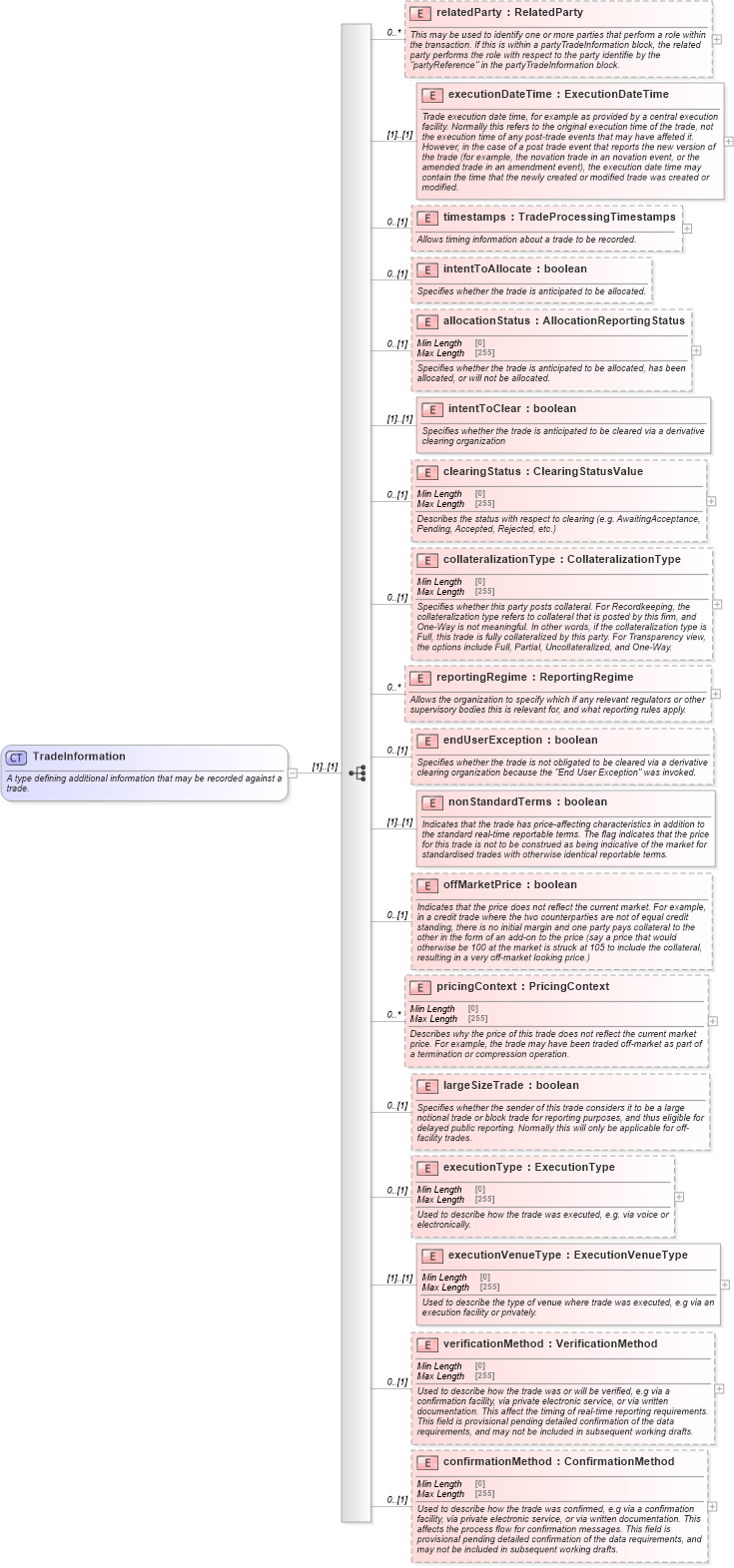
<xsd:complexType name="TradeInformation">
    <xsd:annotation>
        <xsd:documentation xml:lang="en">A type defining additional information that may be recorded against a trade.</xsd:documentation>
    </xsd:annotation>
    <xsd:sequence>
        <xsd:element name="relatedParty" type="RelatedParty" minOccurs="0" maxOccurs="unbounded">
            <xsd:annotation>
                <xsd:documentation xml:lang="en">This may be used to identify one or more parties that perform a role within the transaction. If this is within a partyTradeInformation block, the related party performs the role with respect to the party identifie by the "partyReference" in the partyTradeInformation block.</xsd:documentation>
            </xsd:annotation>
        </xsd:element>
        <xsd:element name="executionDateTime" type="ExecutionDateTime">
            <xsd:annotation>
                <xsd:documentation xml:lang="en">Trade execution date time, for example as provided by a central execution facility. Normally this refers to the original execution time of the trade, not the execution time of any post-trade events that may have affeted it. However, in the case of a post trade event that reports the new version of the trade (for example, the novation trade in an novation event, or the amended trade in an amendment event), the execution date time may contain the time that the newly created or modified trade was created or modified.</xsd:documentation>
            </xsd:annotation>
        </xsd:element>
        <xsd:element name="timestamps" type="TradeProcessingTimestamps" minOccurs="0">
            <xsd:annotation>
                <xsd:documentation xml:lang="en">Allows timing information about a trade to be recorded.</xsd:documentation>
            </xsd:annotation>
        </xsd:element>
        <xsd:element name="intentToAllocate" type="xsd:boolean" minOccurs="0">
            <xsd:annotation>
                <xsd:documentation xml:lang="en">Specifies whether the trade is anticipated to be allocated.</xsd:documentation>
            </xsd:annotation>
        </xsd:element>
        <xsd:element name="allocationStatus" type="AllocationReportingStatus" minOccurs="0">
            <xsd:annotation>
                <xsd:documentation xml:lang="en">Specifies whether the trade is anticipated to be allocated, has been allocated, or will not be allocated.</xsd:documentation>
            </xsd:annotation>
        </xsd:element>
        <xsd:element name="intentToClear" type="xsd:boolean">
            <xsd:annotation>
                <xsd:documentation xml:lang="en">Specifies whether the trade is anticipated to be cleared via a derivative clearing organization</xsd:documentation>
            </xsd:annotation>
        </xsd:element>
        <xsd:element name="clearingStatus" type="ClearingStatusValue" minOccurs="0">
            <xsd:annotation>
                <xsd:documentation xml:lang="en">Describes the status with respect to clearing (e.g. AwaitingAcceptance, Pending, Accepted, Rejected, etc.)</xsd:documentation>
            </xsd:annotation>
        </xsd:element>
        <xsd:element name="collateralizationType" type="CollateralizationType" minOccurs="0">
            <xsd:annotation>
                <xsd:documentation xml:lang="en">Specifies whether this party posts collateral. For Recordkeeping, the collateralization type refers to collateral that is posted by this firm, and One-Way is not meaningful. In other words, if the collateralization type is Full, this trade is fully collateralized by this party. For Transparency view, the options include Full, Partial, Uncollateralized, and One-Way.</xsd:documentation>
            </xsd:annotation>
        </xsd:element>
        <xsd:element name="reportingRegime" type="ReportingRegime" minOccurs="0" maxOccurs="unbounded">
            <xsd:annotation>
                <xsd:documentation xml:lang="en">Allows the organization to specify which if any relevant regulators or other supervisory bodies this is relevant for, and what reporting rules apply.</xsd:documentation>
            </xsd:annotation>
        </xsd:element>
        <xsd:element name="endUserException" type="xsd:boolean" minOccurs="0">
            <xsd:annotation>
                <xsd:documentation xml:lang="en">Specifies whether the trade is not obligated to be cleared via a derivative clearing organization because the "End User Exception" was invoked.</xsd:documentation>
            </xsd:annotation>
        </xsd:element>
        <xsd:element name="nonStandardTerms" type="xsd:boolean">
            <xsd:annotation>
                <xsd:documentation xml:lang="en">Indicates that the trade has price-affecting characteristics in addition to the standard real-time reportable terms. The flag indicates that the price for this trade is not to be construed as being indicative of the market for standardised trades with otherwise identical reportable terms.</xsd:documentation>
            </xsd:annotation>
        </xsd:element>
        <xsd:element name="offMarketPrice" type="xsd:boolean" minOccurs="0">
            <xsd:annotation>
                <xsd:documentation xml:lang="en">Indicates that the price does not reflect the current market. For example, in a credit trade where the two counterparties are not of equal credit standing, there is no initial margin and one party pays collateral to the other in the form of an add-on to the price (say a price that would otherwise be 100 at the market is struck at 105 to include the collateral, resulting in a very off-market looking price.)</xsd:documentation>
            </xsd:annotation>
        </xsd:element>
        <xsd:element name="pricingContext" type="PricingContext" minOccurs="0" maxOccurs="unbounded">
            <xsd:annotation>
                <xsd:documentation xml:lang="en">Describes why the price of this trade does not reflect the current market price. For example, the trade may have been traded off-market as part of a termination or compression operation.</xsd:documentation>
            </xsd:annotation>
        </xsd:element>
        <xsd:element name="largeSizeTrade" type="xsd:boolean" minOccurs="0">
            <xsd:annotation>
                <xsd:documentation xml:lang="en">Specifies whether the sender of this trade considers it to be a large notional trade or block trade for reporting purposes, and thus eligible for delayed public reporting. Normally this will only be applicable for off-facility trades.</xsd:documentation>
            </xsd:annotation>
        </xsd:element>
        <xsd:element name="executionType" type="ExecutionType" minOccurs="0">
            <xsd:annotation>
                <xsd:documentation xml:lang="en">Used to describe how the trade was executed, e.g. via voice or electronically.</xsd:documentation>
            </xsd:annotation>
        </xsd:element>
        <xsd:element name="executionVenueType" type="ExecutionVenueType">
            <xsd:annotation>
                <xsd:documentation xml:lang="en">Used to describe the type of venue where trade was executed, e.g via an execution facility or privately.</xsd:documentation>
            </xsd:annotation>
        </xsd:element>
        <xsd:element name="verificationMethod" type="VerificationMethod" minOccurs="0">
            <xsd:annotation>
                <xsd:documentation xml:lang="en">Used to describe how the trade was or will be verified, e.g via a confirmation facility, via private electronic service, or via written documentation. This affect the timing of real-time reporting requirements. This field is provisional pending detailed confirmation of the data requirements, and may not be included in subsequent working drafts.</xsd:documentation>
            </xsd:annotation>
        </xsd:element>
        <xsd:element name="confirmationMethod" type="ConfirmationMethod" minOccurs="0">
            <xsd:annotation>
                <xsd:documentation xml:lang="en">Used to describe how the trade was confirmed, e.g via a confirmation facility, via private electronic service, or via written documentation. This affects the process flow for confirmation messages. This field is provisional pending detailed confirmation of the data requirements, and may not be included in subsequent working drafts.</xsd:documentation>
            </xsd:annotation>
        </xsd:element>
    </xsd:sequence>
</xsd:complexType>
|
 XSD Schema Diagram: