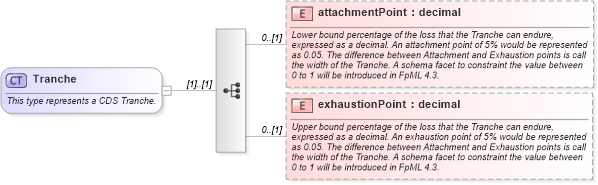
<xsd:complexType name="Tranche">
    <xsd:annotation>
        <xsd:documentation xml:lang="en">This type represents a CDS Tranche.</xsd:documentation>
    </xsd:annotation>
    <xsd:sequence>
        <xsd:element name="attachmentPoint" type="xsd:decimal" minOccurs="0">
            <xsd:annotation>
                <xsd:documentation xml:lang="en">Lower bound percentage of the loss that the Tranche can endure, expressed as a decimal. An attachment point of 5% would be represented as 0.05. The difference between Attachment and Exhaustion points is call the width of the Tranche. A schema facet to constraint the value between 0 to 1 will be introduced in FpML 4.3.</xsd:documentation>
            </xsd:annotation>
        </xsd:element>
        <xsd:element name="exhaustionPoint" type="xsd:decimal" minOccurs="0">
            <xsd:annotation>
                <xsd:documentation xml:lang="en">Upper bound percentage of the loss that the Tranche can endure, expressed as a decimal. An exhaustion point of 5% would be represented as 0.05. The difference between Attachment and Exhaustion points is call the width of the Tranche. A schema facet to constraint the value between 0 to 1 will be introduced in FpML 4.3.</xsd:documentation>
            </xsd:annotation>
        </xsd:element>
    </xsd:sequence>
</xsd:complexType>
|
 XSD Schema Diagram: