Definition Type: Element
Name: varianceCalculation
Namespace: http://www.fpml.org/FpML-5/recordkeeping
Type: nsD:CommodityVarianceCalculation
Containing Schema: fpml-com-5-10.xsd
MinOccurs 0
MaxOccurs (1)
Abstract
Documentation:
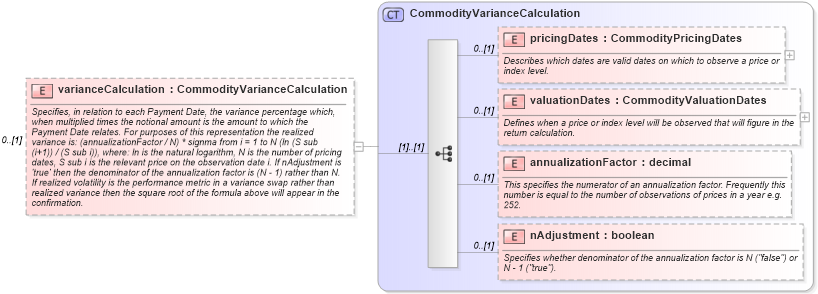
Specifies, in relation to each Payment Date, the variance percentage which, when multiplied times the notional amount is the amount to which the Payment Date relates. For purposes of this representation the realized variance is: (annualizationFactor / N) * signma from i = 1 to N (ln (S sub (i+1)) / (S sub i)), where: ln is the natural logarithm, N is the number of pricing dates, S sub i is the relevant price on the observation date i. If nAdjustment is 'true' then the denominator of the annualization factor is (N - 1) rather than N. If realized volatility is the performance metric in a variance swap rather than realized variance then the square root of the formula above will appear in the confirmation.
Collapse XSD Schema Diagram:
Drilldown into nAdjustment in schema fpml-com-5-10_xsd1 Drilldown into annualizationFactor in schema fpml-com-5-10_xsd1 Drilldown into valuationDates in schema fpml-com-5-10_xsd1 Drilldown into pricingDates in schema fpml-com-5-10_xsd1 Drilldown into CommodityVarianceCalculation in schema fpml-com-5-10_xsd1XSD Diagram of varianceCalculation in schema fpml-com-5-10_xsd1 (Financial products Markup Language (FpML®))
Collapse XSD Schema Code:
<xsd:element name="varianceCalculation" type="CommodityVarianceCalculation" minOccurs="0">
    <xsd:annotation>
        <xsd:documentation xml:lang="en">Specifies, in relation to each Payment Date, the variance percentage which, when multiplied times the notional amount is the amount to which the Payment Date relates. For purposes of this representation the realized variance is: (annualizationFactor / N) * signma from i = 1 to N (ln (S sub (i+1)) / (S sub i)), where: ln is the natural logarithm, N is the number of pricing dates, S sub i is the relevant price on the observation date i. If nAdjustment is 'true' then the denominator of the annualization factor is (N - 1) rather than N. If realized volatility is the performance metric in a variance swap rather than realized variance then the square root of the formula above will appear in the confirmation.</xsd:documentation>
    </xsd:annotation>
</xsd:element>
Collapse Child Elements:
Name Type Min Occurs Max Occurs
pricingDates nsD:pricingDates 0 (1)
valuationDates nsD:valuationDates 0 (1)
annualizationFactor nsD:annualizationFactor 0 (1)
nAdjustment nsD:nAdjustment 0 (1)
Collapse Derivation Tree: