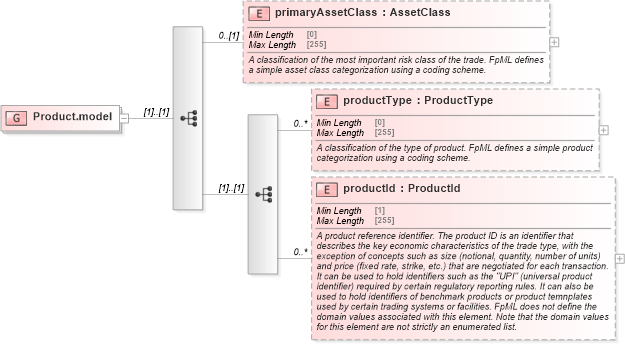
<xsd:group name="Product.model">
    <xsd:sequence>
        <xsd:element name="primaryAssetClass" type="AssetClass" minOccurs="0">
            <xsd:annotation>
                <xsd:documentation xml:lang="en">A classification of the most important risk class of the trade. FpML defines a simple asset class categorization using a coding scheme.</xsd:documentation>
            </xsd:annotation>
        </xsd:element>
        <!--View Generation: SKIPPED secondaryAssetClass - Unsupported-->
        <!--View Generation: Removed a degenerate choice.-->
        <xsd:sequence>
            <xsd:element name="productType" type="ProductType" minOccurs="0" maxOccurs="unbounded">
                <xsd:annotation>
                    <xsd:documentation xml:lang="en">A classification of the type of product. FpML defines a simple product categorization using a coding scheme.</xsd:documentation>
                </xsd:annotation>
            </xsd:element>
            <xsd:element name="productId" type="ProductId" minOccurs="0" maxOccurs="unbounded">
                <xsd:annotation>
                    <xsd:documentation xml:lang="en">A product reference identifier. The product ID is an identifier that describes the key economic characteristics of the trade type, with the exception of concepts such as size (notional, quantity, number of units) and price (fixed rate, strike, etc.) that are negotiated for each transaction. It can be used to hold identifiers such as the "UPI" (universal product identifier) required by certain regulatory reporting rules. It can also be used to hold identifiers of benchmark products or product temnplates used by certain trading systems or facilities. FpML does not define the domain values associated with this element. Note that the domain values for this element are not strictly an enumerated list.</xsd:documentation>
                </xsd:annotation>
            </xsd:element>
        </xsd:sequence>
        <!--View Generation: SKIPPED assetClass - Other-new view doesn't need to maintain compatibility with deprecated sequence-->
        <!--View Generation: SKIPPED embeddedOptionType - Unsupported-->
    </xsd:sequence>
</xsd:group>
|
 XSD Schema Diagram: