Definition Type: Element
Name: relativeDates
Namespace: http://www.fpml.org/FpML-5/transparency
Type: nsA:RelativeDates
Containing Schema: fpml-shared-5-9.xsd
MinOccurs (1)
MaxOccurs (1)
Abstract
Documentation:
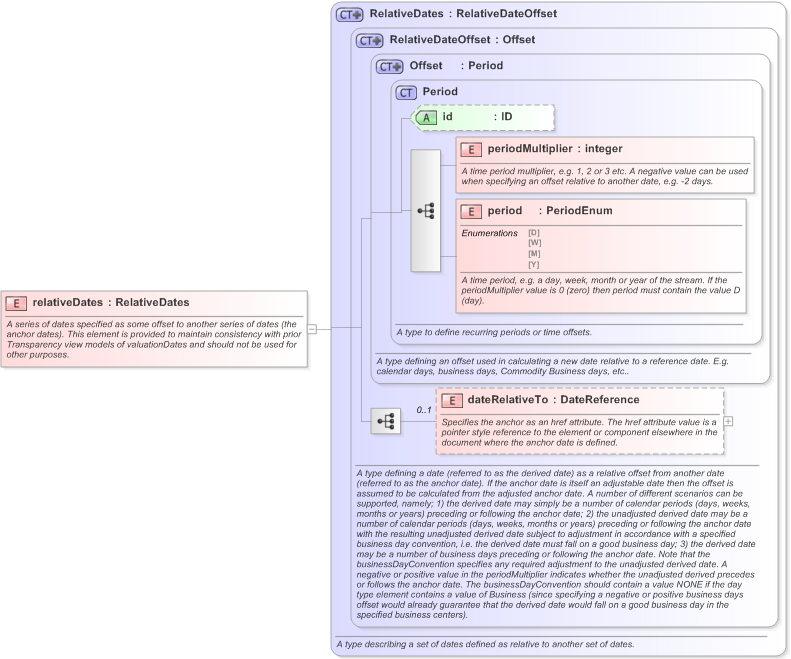
A series of dates specified as some offset to another series of dates (the anchor dates). This element is provided to maintain consistency with prior Transparency view models of valuationDates and should not be used for other purposes.
Collapse XSD Schema Diagram:
Drilldown into dateRelativeTo in schema fpml-shared-5-9_xsd Drilldown into period in schema fpml-shared-5-9_xsd Drilldown into periodMultiplier in schema fpml-shared-5-9_xsd Drilldown into id in schema fpml-shared-5-9_xsd Drilldown into Period in schema fpml-shared-5-9_xsd Drilldown into Offset in schema fpml-shared-5-9_xsd Drilldown into RelativeDateOffset in schema fpml-shared-5-9_xsd Drilldown into RelativeDates in schema fpml-shared-5-9_xsdXSD Diagram of relativeDates in schema fpml-shared-5-9_xsd (Financial products Markup Language (FpML®) - Transparency)
Collapse XSD Schema Code:
<xsd:element name="relativeDates" type="RelativeDates">
    <xsd:annotation>
        <xsd:documentation xml:lang="en">A series of dates specified as some offset to another series of dates (the anchor dates). This element is provided to maintain consistency with prior Transparency view models of valuationDates and should not be used for other purposes.</xsd:documentation>
    </xsd:annotation>
</xsd:element>
Collapse Child Elements:
Name Type Min Occurs Max Occurs
periodMultiplier nsA:periodMultiplier (1) (1)
period nsA:period (1) (1)
dateRelativeTo nsA:dateRelativeTo 0 (1)
Collapse Child Attributes:
Name Type Default Value Use
id nsA:id (Optional)
Collapse Derivation Tree:
Collapse Comments:
blog comments powered by Disqus