Definition Type: ComplexType
Name: AbstractTimeType
Namespace: http://www.opengis.net/gml
Type: gml:AbstractGMLType
Containing Schema: temporal.xsd
Abstract True
Documentation:
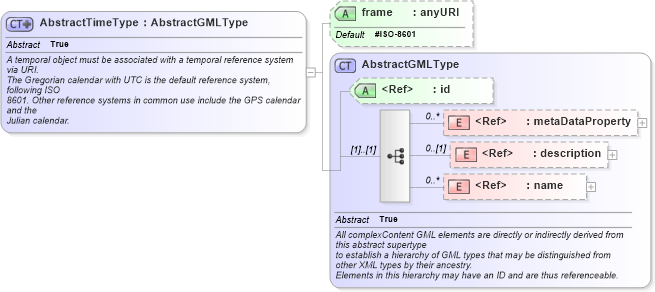
A temporal object must be associated with a temporal reference system via URI. The Gregorian calendar with UTC is the default reference system, following ISO 8601. Other reference systems in common use include the GPS calendar and the Julian calendar.
Collapse XSD Schema Diagram:
Drilldown into name in schema gmlbase_xsd Drilldown into description in schema gmlbase_xsd Drilldown into metaDataProperty in schema gmlbase_xsd Drilldown into id in schema gmlbase_xsd Drilldown into AbstractGMLType in schema gmlbase_xsd Drilldown into frame in schema temporal_xsdXSD Diagram of AbstractTimeType in schema temporal_xsd (Geography Markup Language)
Collapse XSD Schema Code:
<complexType name="AbstractTimeType" abstract="true">
    <annotation>
        <documentation xml:lang="en">
       A temporal object must be associated with a temporal reference system via URI. 
       The Gregorian calendar with UTC is the default reference system, following ISO 
       8601. Other reference systems in common use include the GPS calendar and the 
       Julian calendar.
      </documentation>
    </annotation>
    <complexContent>
        <extension base="gml:AbstractGMLType">
            <attribute name="frame" type="anyURI" use="optional" default="#ISO-8601" />
        </extension>
    </complexContent>
</complexType>
Collapse Child Elements:
Name Type Min Occurs Max Occurs
metaDataProperty gml:metaDataProperty 0 unbounded
description gml:description 0 (1)
name gml:name 0 unbounded
Collapse Child Attributes:
Name Type Default Value Use
id gml:id Optional
frame gml:frame #ISO-8601 Optional
Collapse Derivation Tree:
Collapse References:
gml:_TimeObjectgml:TimePrimitiveType,