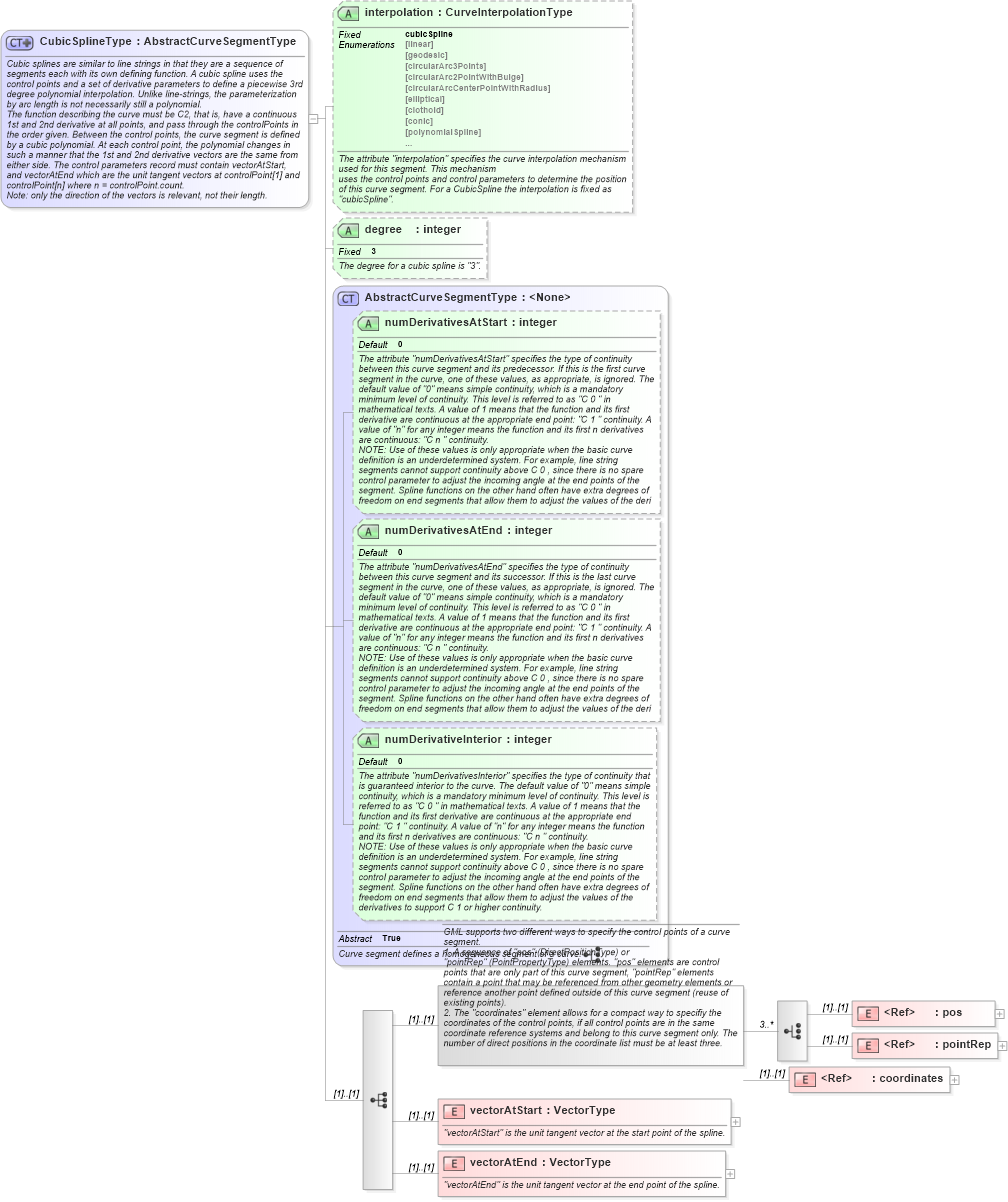
<complexType name="CubicSplineType">
    <annotation>
        <documentation>
				Cubic splines are similar to line strings in that they are a sequence of segments each with its own defining function. A cubic spline uses the control points and a set of derivative parameters to define a piecewise 3rd degree polynomial interpolation. Unlike line-strings, the parameterization by arc length is not necessarily still a polynomial.
				The function describing the curve must be C2, that is, have a continuous 1st and 2nd derivative at all points, and pass through the controlPoints in the order given. Between the control points, the curve segment is defined by a cubic polynomial. At each control point, the polynomial changes in such a manner that the 1st and 2nd derivative vectors are the same from either side. The control parameters record must contain vectorAtStart, and vectorAtEnd which are the unit tangent vectors at controlPoint[1] and controlPoint[n] where n = controlPoint.count.
				Note: only the direction of the vectors is relevant, not their length.
			</documentation>
    </annotation>
    <complexContent>
        <extension base="gml:AbstractCurveSegmentType">
            <sequence>
                <choice>
                    <annotation>
                        <documentation>GML supports two different ways to specify the control points of a curve segment.
1. A sequence of "pos" (DirectPositionType) or "pointRep" (PointPropertyType) elements. "pos" elements are control points that are only part of this curve segment, "pointRep" elements contain a point that may be referenced from other geometry elements or reference another point defined outside of this curve segment (reuse of existing points).
2. The "coordinates" element allows for a compact way to specifiy the coordinates of the control points, if all control points are in the same coordinate reference systems and belong to this curve segment only. The number of direct positions in the coordinate list must be at least three.</documentation>
                    </annotation>
                    <choice minOccurs="3" maxOccurs="unbounded">
                        <element ref="gml:pos" />
                        <element ref="gml:pointRep" />
                    </choice>
                    <element ref="gml:coordinates" />
                </choice>
                <element name="vectorAtStart" type="gml:VectorType">
                    <annotation>
                        <documentation>"vectorAtStart" is the unit tangent vector at the start point of the spline.</documentation>
                    </annotation>
                </element>
                <element name="vectorAtEnd" type="gml:VectorType">
                    <annotation>
                        <documentation>"vectorAtEnd" is the unit tangent vector at the end point of the spline.</documentation>
                    </annotation>
                </element>
            </sequence>
            <attribute name="interpolation" type="gml:CurveInterpolationType" fixed="cubicSpline">
                <annotation>
                    <documentation>The attribute "interpolation" specifies the curve interpolation mechanism used for this segment. This mechanism
uses the control points and control parameters to determine the position of this curve segment. For a CubicSpline the interpolation is fixed as "cubicSpline".</documentation>
                </annotation>
            </attribute>
            <attribute name="degree" type="integer" fixed="3">
                <annotation>
                    <documentation>The degree for a cubic spline is "3".</documentation>
                </annotation>
            </attribute>
        </extension>
    </complexContent>
</complexType>
|
 XSD Schema Diagram: