Definition Type: ComplexType
Name: SurfaceType
Namespace: http://www.opengis.net/gml
Type: gml:AbstractSurfaceType
Containing Schema: geometryPrimitives.xsd
Abstract
Documentation:
A Surface is a 2-dimensional primitive and is composed of one or more surface patches. The surface patches are connected to one another. The orientation of the surface is positive ("up"). The orientation of a surface chooses an "up" direction through the choice of the upward normal, which, if the surface is not a cycle, is the side of the surface from which the exterior boundary appears counterclockwise. Reversal of the surface orientation reverses the curve orientation of each boundary component, and interchanges the conceptual "up" and "down" direction of the surface. If the surface is the boundary of a solid, the "up" direction is usually outward. For closed surfaces, which have no boundary, the up direction is that of the surface patches, which must be consistent with one another. Its included surface patches describe the interior structure of the Surface.
Collapse XSD Schema Diagram:
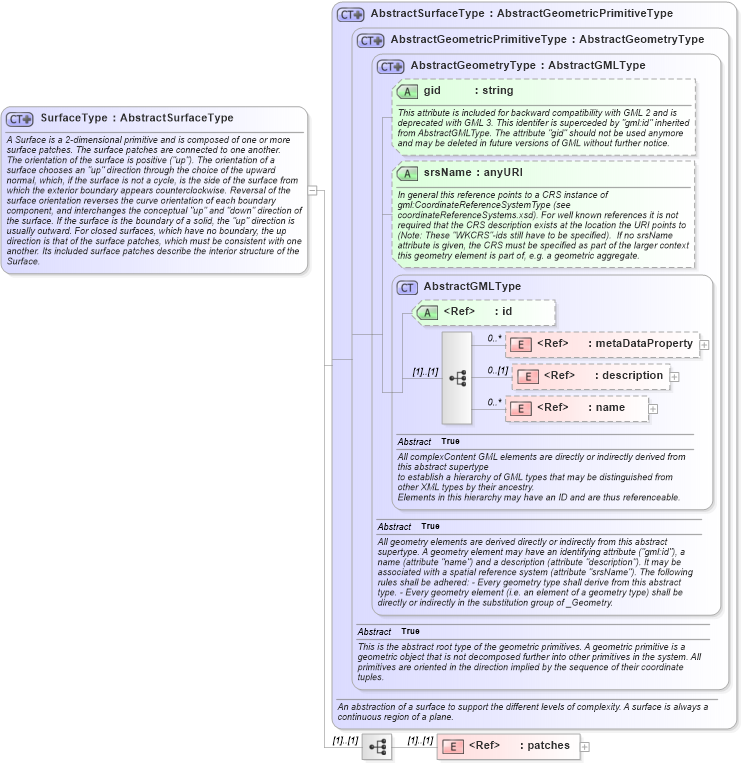
Drilldown into patches in schema geometryprimitives_xsd Drilldown into name in schema gmlbase_xsd Drilldown into description in schema gmlbase_xsd Drilldown into metaDataProperty in schema gmlbase_xsd Drilldown into id in schema gmlbase_xsd Drilldown into AbstractGMLType in schema gmlbase_xsd Drilldown into srsName in schema geometrybasic0d1d_xsd Drilldown into gid in schema geometrybasic0d1d_xsd Drilldown into AbstractGeometryType in schema geometrybasic0d1d_xsd Drilldown into AbstractGeometricPrimitiveType in schema geometrybasic0d1d_xsd Drilldown into AbstractSurfaceType in schema geometrybasic2d_xsdXSD Diagram of SurfaceType in schema geometryprimitives_xsd (Geography Markup Language)
Collapse XSD Schema Code:
<complexType name="SurfaceType">
    <annotation>
        <documentation>
				A Surface is a 2-dimensional primitive and is composed of one or more surface patches. The surface patches are connected to one another.
				The orientation of the surface is positive ("up"). The orientation of a surface chooses an "up" direction through the choice of the upward normal, which, if the surface is not a cycle, is the side of the surface from which the exterior boundary appears counterclockwise. Reversal of the surface orientation reverses the curve orientation of each boundary component, and interchanges the conceptual "up" and "down" direction of the surface. If the surface is the boundary of a solid, the "up" direction is usually outward. For closed surfaces, which have no boundary, the up direction is that of the surface patches, which must be consistent with one another. Its included surface patches describe the interior structure of the Surface.
			</documentation>
    </annotation>
    <complexContent>
        <extension base="gml:AbstractSurfaceType">
            <sequence>
                <element ref="gml:patches">
                    <annotation>
                        <documentation>This element encapsulates the patches of the surface.</documentation>
                    </annotation>
                </element>
            </sequence>
        </extension>
    </complexContent>
</complexType>
Collapse Child Elements:
Name Type Min Occurs Max Occurs
metaDataProperty gml:metaDataProperty 0 unbounded
description gml:description 0 (1)
name gml:name 0 unbounded
patches gml:patches (1) (1)
Collapse Child Attributes:
Name Type Default Value Use
id gml:id Optional
gid gml:gid Optional
srsName gml:srsName Optional
Collapse Derivation Tree:
Collapse References:
gml:Surface