<simpleType name="TemporalPositionType">
    <annotation>
        <documentation xml:lang="en">
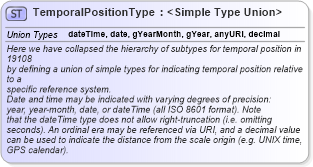
      Here we have collapsed the hierarchy of subtypes for temporal position in 19108
      by defining a union of simple types for indicating temporal position relative to a
      specific reference system.
      Date and time may be indicated with varying degrees of precision:
      year, year-month, date, or dateTime (all ISO 8601 format). Note
      that the dateTime type does not allow right-truncation (i.e. omitting
      seconds). An ordinal era may be referenced via URI, and a decimal value
      can be used to indicate the distance from the scale origin (e.g. UNIX time,
      GPS calendar).
      </documentation>
    </annotation>
    <union memberTypes="dateTime date gYearMonth gYear anyURI decimal" />
</simpleType>
|
 XSD Schema Diagram: