Definition Type: ComplexType
Name: TimeOrdinalEraType
Namespace: http://www.opengis.net/gml
Type: gml:AbstractGMLType
Containing Schema: temporal.xsd
Abstract
Documentation:
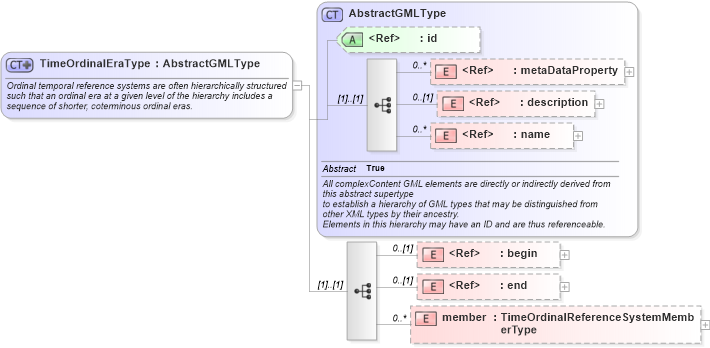
Ordinal temporal reference systems are often hierarchically structured such that an ordinal era at a given level of the hierarchy includes a sequence of shorter, coterminous ordinal eras.
Collapse XSD Schema Diagram:
Drilldown into member in schema temporal_xsd Drilldown into end in schema temporal_xsd Drilldown into begin in schema temporal_xsd Drilldown into name in schema gmlbase_xsd Drilldown into description in schema gmlbase_xsd Drilldown into metaDataProperty in schema gmlbase_xsd Drilldown into id in schema gmlbase_xsd Drilldown into AbstractGMLType in schema gmlbase_xsdXSD Diagram of TimeOrdinalEraType in schema temporal_xsd (Geography Markup Language)
Collapse XSD Schema Code:
<complexType name="TimeOrdinalEraType">
    <annotation>
        <documentation xml:lang="en">
      Ordinal temporal reference systems are often hierarchically structured 
      such that an ordinal era at a given level of the hierarchy includes a 
      sequence of shorter, coterminous ordinal eras.
      </documentation>
    </annotation>
    <complexContent>
        <extension base="gml:AbstractGMLType">
            <sequence>
                <element ref="gml:begin" minOccurs="0" />
                <element ref="gml:end" minOccurs="0" />
                <element name="member" type="gml:TimeOrdinalReferenceSystemMemberType" minOccurs="0" maxOccurs="unbounded" />
            </sequence>
        </extension>
    </complexContent>
</complexType>
Collapse Child Elements:
Name Type Min Occurs Max Occurs
metaDataProperty gml:metaDataProperty 0 unbounded
description gml:description 0 (1)
name gml:name 0 unbounded
begin gml:begin 0 (1)
end gml:end 0 (1)
member gml:member 0 unbounded
Collapse Child Attributes:
Name Type Default Value Use
id gml:id Optional
Collapse Derivation Tree:
Collapse References:
gml:TimeOrdinalEra