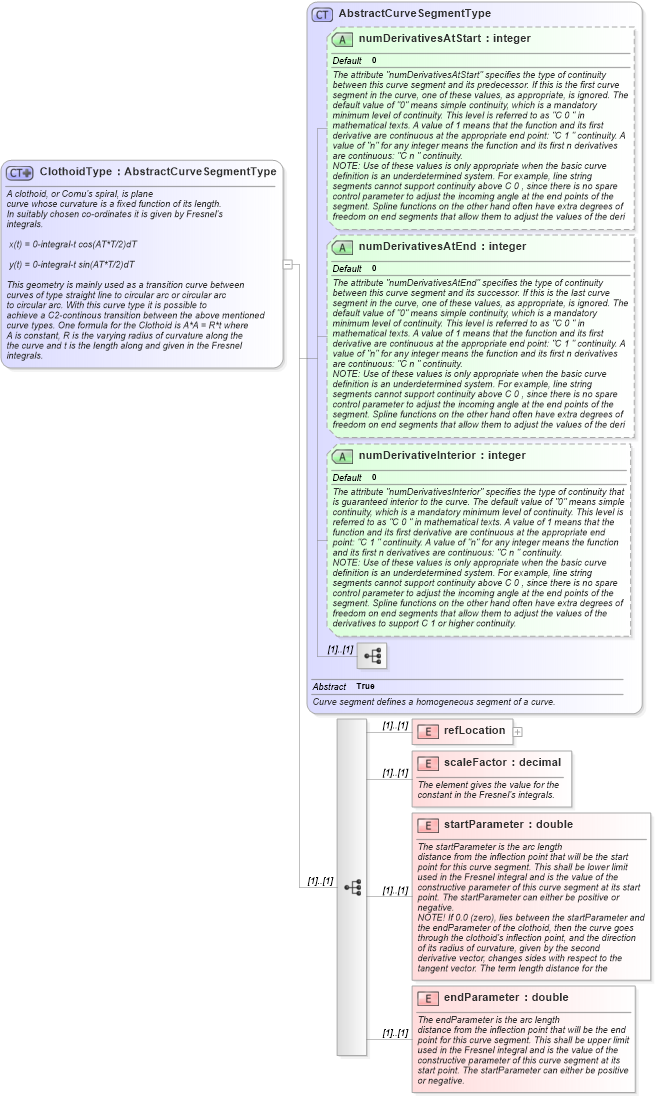
<complexType name="ClothoidType">
    <annotation>
        <documentation>A clothoid, or Cornu's spiral, is plane
   curve whose curvature is a fixed function of its length.
   In suitably chosen co-ordinates it is given by Fresnel's
   integrals.

    x(t) = 0-integral-t cos(AT*T/2)dT

    y(t) = 0-integral-t sin(AT*T/2)dT

   This geometry is mainly used as a transition curve between
   curves of type straight line to circular arc or circular arc
   to circular arc. With this curve type it is possible to
   achieve a C2-continous transition between the above mentioned
   curve types. One formula for the Clothoid is A*A = R*t where
   A is constant, R is the varying radius of curvature along the
   the curve and t is the length along and given in the Fresnel
   integrals.</documentation>
    </annotation>
    <complexContent>
        <extension base="gml:AbstractCurveSegmentType">
            <sequence>
                <element name="refLocation">
                    <complexType>
                        <sequence>
                            <element ref="gml:AffinePlacement">
                                <annotation>
                                    <documentation>The "refLocation" is an affine mapping
          that places  the curve defined by the Fresnel Integrals
          into the co-ordinate reference system of this object.</documentation>
                                </annotation>
                            </element>
                        </sequence>
                    </complexType>
                </element>
                <element name="scaleFactor" type="decimal">
                    <annotation>
                        <documentation>The element gives the value for the
       constant in the Fresnel's integrals.</documentation>
                    </annotation>
                </element>
                <element name="startParameter" type="double">
                    <annotation>
                        <documentation>The startParameter is the arc length
       distance from the inflection point that will be the start
       point for this curve segment. This shall be lower limit
       used in the Fresnel integral and is the value of the
       constructive parameter of this curve segment at its start
       point. The startParameter can either be positive or
       negative.
       NOTE! If 0.0 (zero), lies between the startParameter and
       the endParameter of the clothoid, then the curve goes
       through the clothoid's inflection point, and the direction
       of its radius of curvature, given by the second
       derivative vector, changes sides with respect to the
       tangent vector. The term length distance for the</documentation>
                    </annotation>
                </element>
                <element name="endParameter" type="double">
                    <annotation>
                        <documentation>The endParameter is the arc length
       distance from the inflection point that will be the end
       point for this curve segment. This shall be upper limit
       used in the Fresnel integral and is the value of the
       constructive parameter of this curve segment at its
       start point. The startParameter can either be positive
       or negative.</documentation>
                    </annotation>
                </element>
            </sequence>
        </extension>
    </complexContent>
</complexType>
|
 XSD Schema Diagram: