Definition Type: ComplexType
Name: TimeClockType
Namespace: http://www.opengis.net/gml
Type: gml:AbstractTimeReferenceSystemType
Containing Schema: temporalReferenceSystems.xsd
Abstract
Documentation:
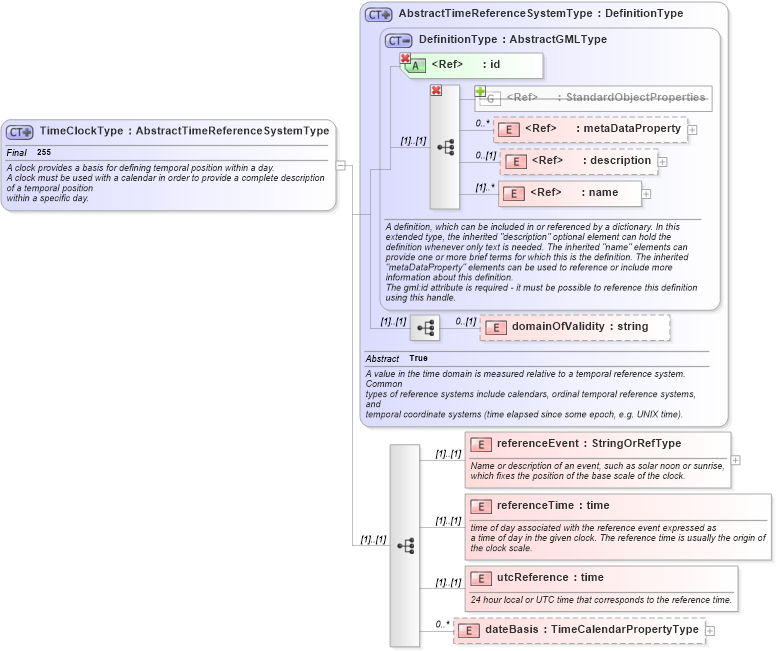
A clock provides a basis for defining temporal position within a day. A clock must be used with a calendar in order to provide a complete description of a temporal position within a specific day.
Collapse XSD Schema Diagram:
Drilldown into dateBasis in schema temporalreferencesystems_xsd Drilldown into utcReference in schema temporalreferencesystems_xsd Drilldown into referenceTime in schema temporalreferencesystems_xsd Drilldown into referenceEvent in schema temporalreferencesystems_xsd Drilldown into domainOfValidity in schema temporalreferencesystems_xsd Drilldown into name in schema gmlbase_xsd Drilldown into description in schema gmlbase_xsd Drilldown into metaDataProperty in schema gmlbase_xsd Drilldown into StandardObjectProperties in schema gmlbase_xsd Drilldown into id in schema gmlbase_xsd Drilldown into DefinitionType in schema dictionary_xsd Drilldown into AbstractTimeReferenceSystemType in schema temporalreferencesystems_xsdXSD Diagram of TimeClockType in schema temporalreferencesystems_xsd (Geography Markup Language)
Collapse XSD Schema Code:
<complexType name="TimeClockType" final="#all">
    <annotation>
        <documentation xml:lang="en">A clock provides a basis for defining temporal position within a day. 
      A clock must be used with a calendar in order to provide a complete description of a temporal position 
      within a specific day.</documentation>
    </annotation>
    <complexContent>
        <extension base="gml:AbstractTimeReferenceSystemType">
            <sequence>
                <element name="referenceEvent" type="gml:StringOrRefType">
                    <annotation>
                        <documentation>Name or description of an event, such as solar noon or sunrise, 
              which fixes the position of the base scale of the clock.</documentation>
                    </annotation>
                </element>
                <element name="referenceTime" type="time">
                    <annotation>
                        <documentation>time of day associated with the reference event expressed as 
              a time of day in the given clock. The reference time is usually the origin of the clock scale.</documentation>
                    </annotation>
                </element>
                <element name="utcReference" type="time">
                    <annotation>
                        <documentation>24 hour local or UTC time that corresponds to the reference time.</documentation>
                    </annotation>
                </element>
                <element name="dateBasis" type="gml:TimeCalendarPropertyType" minOccurs="0" maxOccurs="unbounded" />
            </sequence>
        </extension>
    </complexContent>
</complexType>
Collapse Child Elements:
Name Type Min Occurs Max Occurs
metaDataProperty gml:metaDataProperty 0 unbounded
description gml:description 0 (1)
name gml:name 0 unbounded
metaDataProperty gml:metaDataProperty 0 unbounded
description gml:description 0 (1)
name gml:name (1) unbounded
domainOfValidity gml:domainOfValidity 0 (1)
referenceEvent gml:referenceEvent (1) (1)
referenceTime gml:referenceTime (1) (1)
utcReference gml:utcReference (1) (1)
dateBasis gml:dateBasis 0 unbounded
<xs:group> gml:StandardObjectProperties (1) (1)
Collapse Child Attributes:
Name Type Default Value Use
id gml:id Required
Collapse Derivation Tree:
Collapse References:
gml:TimeClock