Definition Type: Element
Name: TimeOrdinalReferenceSystem
Namespace: http://www.opengis.net/gml/3.2
Type: gml:TimeOrdinalReferenceSystemType
Containing Schema: temporalReferenceSystems.xsd
Abstract
Documentation:
In some applications of geographic information — such as geology and archaeology — relative position in time is known more precisely than absolute time or duration. The order of events in time can be well established, but the magnitude of the intervals between them cannot be accurately determined; in such cases, the use of an ordinal temporal reference system is appropriate. An ordinal temporal reference system is composed of a sequence of named coterminous eras, which may in turn be composed of sequences of member eras at a finer scale, giving the whole a hierarchical structure of eras of verying resolution. An ordinal temporal reference system whose component eras are not further subdivided is effectively a temporal topological complex constrained to be a linear graph. An ordinal temporal reference system some or all of whose component eras are subdivided is effectively a temporal topological complex with the constraint that parallel branches may only be constructed in pairs where one is a single temporal ordinal era and the other is a sequence of temporal ordinal eras that are called "members" of the "group". This constraint means that within a single temporal ordinal reference system, the relative position of all temporal ordinal eras is unambiguous. The positions of the beginning and end of a given era may calibrate the relative time scale. gml:TimeOrdinalReferenceSystem adds one or more gml:component properties to the generic temporal reference system model.
Collapse XSD Schema Diagram:
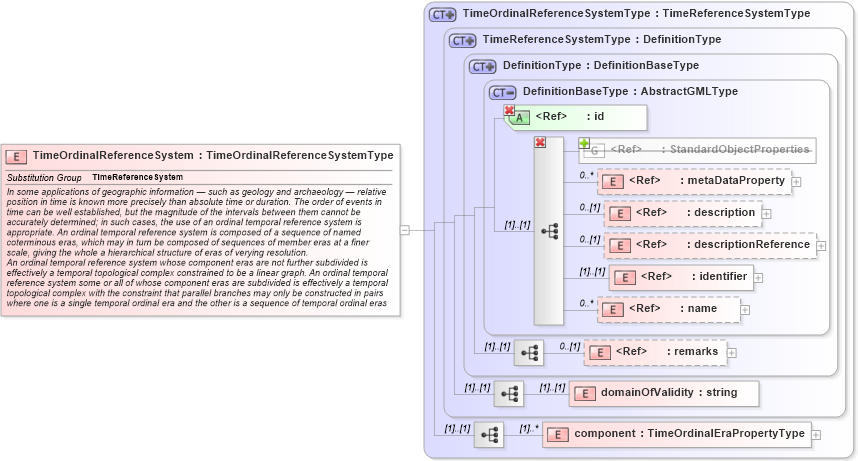
Drilldown into component in schema temporalreferencesystems_xsd Drilldown into domainOfValidity in schema temporalreferencesystems_xsd Drilldown into remarks in schema dictionary_xsd Drilldown into name in schema gmlbase_xsd Drilldown into identifier in schema gmlbase_xsd Drilldown into descriptionReference in schema gmlbase_xsd Drilldown into description in schema gmlbase_xsd Drilldown into metaDataProperty in schema deprecatedtypes_xsd Drilldown into StandardObjectProperties in schema gmlbase_xsd Drilldown into id in schema gmlbase_xsd Drilldown into DefinitionBaseType in schema dictionary_xsd Drilldown into DefinitionType in schema dictionary_xsd Drilldown into TimeReferenceSystemType in schema temporalreferencesystems_xsd Drilldown into TimeOrdinalReferenceSystemType in schema temporalreferencesystems_xsdXSD Diagram of TimeOrdinalReferenceSystem in schema temporalreferencesystems_xsd (Geography Markup Language)
Collapse XSD Schema Code:
<element name="TimeOrdinalReferenceSystem" type="gml:TimeOrdinalReferenceSystemType" substitutionGroup="gml:TimeReferenceSystem">
    <annotation>
        <documentation>In some applications of geographic information — such as geology and archaeology — relative position in time is known more precisely than absolute time or duration. The order of events in time can be well established, but the magnitude of the intervals between them cannot be accurately determined; in such cases, the use of an ordinal temporal reference system is appropriate. An ordinal temporal reference system is composed of a sequence of named coterminous eras, which may in turn be composed of sequences of member eras at a finer scale, giving the whole a hierarchical structure of eras of verying resolution. 
An ordinal temporal reference system whose component eras are not further subdivided is effectively a temporal topological complex constrained to be a linear graph. An ordinal temporal reference system some or all of whose component eras are subdivided is effectively a temporal topological complex with the constraint that parallel branches may only be constructed in pairs where one is a single temporal ordinal era and the other is a sequence of temporal ordinal eras that are called "members" of the "group". This constraint means that within a single temporal ordinal reference system, the relative position of all temporal ordinal eras is unambiguous.  
The positions of the beginning and end of a given era may calibrate the relative time scale.
gml:TimeOrdinalReferenceSystem adds one or more gml:component properties to the generic temporal reference system model.</documentation>
    </annotation>
</element>
Collapse Child Elements:
Name Type Min Occurs Max Occurs
metaDataProperty gml:metaDataProperty 0 unbounded
description gml:description 0 (1)
descriptionReference gml:descriptionReference 0 (1)
identifier gml:identifier 0 (1)
name gml:name 0 unbounded
metaDataProperty gml:metaDataProperty 0 unbounded
description gml:description 0 (1)
descriptionReference gml:descriptionReference 0 (1)
identifier gml:identifier (1) (1)
name gml:name 0 unbounded
remarks gml:remarks 0 (1)
domainOfValidity gml:domainOfValidity (1) (1)
component gml:component (1) unbounded
<xs:group> gml:StandardObjectProperties (1) (1)
Collapse Child Attributes:
Name Type Default Value Use
id gml:id Required
Collapse Derivation Tree:
Collapse References:
gml:TimeReferenceSystem