Definition Type: ComplexType
Name: AcknowledgeIndicativeDataType
Namespace: http://www.hr-xml.org/3
Type: oa:BusinessObjectDocumentType
Containing Schema: AcknowledgeIndicativeData.xsd
Abstract
Documentation:
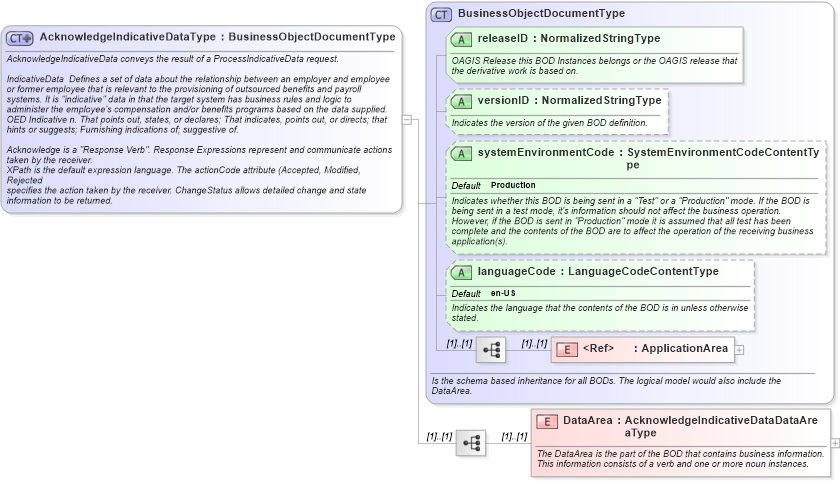
AcknowledgeIndicativeData conveys the result of a ProcessIndicativeData request. IndicativeData Defines a set of data about the relationship between an employer and employee or former employee that is relevant to the provisioning of outsourced benefits and payroll systems. It is "indicative" data in that the target system has business rules and logic to administer the employee's compensation and/or benefits programs based on the data supplied. OED Indicative n. That points out, states, or declares; That indicates, points out, or directs; that hints or suggests; Furnishing indications of; suggestive of. Acknowledge is a "Response Verb". Response Expressions represent and communicate actions taken by the receiver. XPath is the default expression language. The actionCode attribute (Accepted, Modified, Rejected specifies the action taken by the receiver. ChangeStatus allows detailed change and state information to be returned.
Collapse XSD Schema Diagram:
Drilldown into DataArea in schema acknowledgeindicativedata_xsd Drilldown into ApplicationArea in schema meta_xsd Drilldown into languageCode in schema meta_xsd Drilldown into systemEnvironmentCode in schema meta_xsd Drilldown into versionID in schema meta_xsd Drilldown into releaseID in schema meta_xsd Drilldown into BusinessObjectDocumentType in schema meta_xsdXSD Diagram of AcknowledgeIndicativeDataType in schema acknowledgeindicativedata_xsd (HR-XML - Human Resources XML)
Collapse XSD Schema Code:
<xsd:complexType name="AcknowledgeIndicativeDataType">
    <xsd:annotation>
        <xsd:documentation> 
       AcknowledgeIndicativeData conveys the result of a ProcessIndicativeData request. 

       IndicativeData  Defines a set of data about the relationship between an employer and employee or former employee that is relevant to the provisioning of outsourced benefits and payroll systems. It is "indicative" data in that the target system has business rules and logic to administer the employee's compensation and/or benefits programs based on the data supplied. OED Indicative n. That points out, states, or declares; That indicates, points out, or directs; that hints or suggests; Furnishing indications of; suggestive of. 

       Acknowledge is a "Response Verb". Response Expressions represent and communicate actions taken by the receiver. 
       XPath is the default expression language. The actionCode attribute (Accepted, Modified, Rejected  
       specifies the action taken by the receiver. ChangeStatus allows detailed change and state information to be returned.
       </xsd:documentation>
    </xsd:annotation>
    <xsd:complexContent>
        <xsd:extension base="oa:BusinessObjectDocumentType">
            <xsd:sequence>
                <xsd:element name="DataArea" type="AcknowledgeIndicativeDataDataAreaType">
                    <xsd:annotation>
                        <xsd:documentation>The DataArea is the part of the BOD that contains business information. This information consists of a verb and one or more noun instances. </xsd:documentation>
                    </xsd:annotation>
                </xsd:element>
            </xsd:sequence>
        </xsd:extension>
    </xsd:complexContent>
</xsd:complexType>
Collapse Child Elements:
Name Type Min Occurs Max Occurs
ApplicationArea oa:ApplicationArea (1) (1)
DataArea nsA:DataArea (1) (1)
Collapse Child Attributes:
Name Type Default Value Use
releaseID oa:releaseID Required
versionID oa:versionID Optional
systemEnvironmentCode oa:systemEnvironmentCode Production Optional
languageCode oa:languageCode en-US Optional
Collapse Derivation Tree:
Collapse References:
nsA:AcknowledgeIndicativeData