Definition Type: ComplexType
Name: DeferralType
Namespace: http://www.hr-xml.org/3
Containing Schema: Components.xsd
Abstract
Documentation:
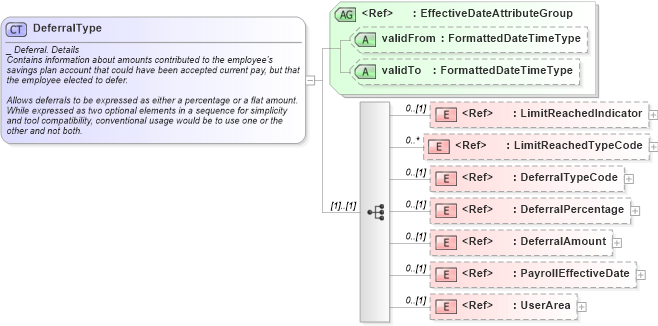
_ Deferral. Details Contains information about amounts contributed to the employee's savings plan account that could have been accepted current pay, but that the employee elected to defer. Allows deferrals to be expressed as either a percentage or a flat amount. While expressed as two optional elements in a sequence for simplicity and tool compatibility, conventional usage would be to use one or the other and not both.
Collapse XSD Schema Diagram:
Drilldown into UserArea in schema fields_xsd Drilldown into PayrollEffectiveDate in schema fields_xsd Drilldown into DeferralAmount in schema fields_xsd Drilldown into DeferralPercentage in schema fields_xsd Drilldown into DeferralTypeCode in schema fields_xsd Drilldown into LimitReachedTypeCode in schema fields_xsd Drilldown into LimitReachedIndicator in schema fields_xsd Drilldown into validTo in schema fields_xsd Drilldown into validFrom in schema fields_xsd Drilldown into EffectiveDateAttributeGroup in schema fields_xsdXSD Diagram of DeferralType in schema components_xsd (HR-XML - Human Resources XML)
Collapse XSD Schema Code:
<xsd:complexType name="DeferralType">
    <xsd:annotation>
        <xsd:documentation source="http://www.hr-xml.org" xml:lang="en">
            <ccts:DictionaryEntryName xmlns:ccts="urn:un:unece:uncefact:documentation:1.1">_ Deferral. Details</ccts:DictionaryEntryName>
            <ccts:DefinitionText xmlns:ccts="urn:un:unece:uncefact:documentation:1.1">Contains information about amounts contributed to the employee's savings plan account that could have been accepted current pay, but that the employee elected to defer.
</ccts:DefinitionText>
            <ccts:DefinitionUsage xmlns:ccts="urn:un:unece:uncefact:documentation:1.1">Allows deferrals to be expressed as either a percentage or a flat amount. While expressed as two optional elements in a sequence for simplicity and tool compatibility, conventional usage would be to use one or the other and not both.</ccts:DefinitionUsage>
        </xsd:documentation>
    </xsd:annotation>
    <xsd:sequence>
        <xsd:element ref="LimitReachedIndicator" minOccurs="0" />
        <xsd:element ref="LimitReachedTypeCode" minOccurs="0" maxOccurs="unbounded" />
        <xsd:element ref="DeferralTypeCode" minOccurs="0" />
        <xsd:element ref="DeferralPercentage" minOccurs="0" />
        <xsd:element ref="DeferralAmount" minOccurs="0" />
        <xsd:element ref="PayrollEffectiveDate" minOccurs="0" />
        <xsd:element ref="UserArea" minOccurs="0" />
    </xsd:sequence>
    <xsd:attributeGroup ref="EffectiveDateAttributeGroup" />
</xsd:complexType>
Collapse Child Elements:
Name Type Min Occurs Max Occurs
LimitReachedIndicator nsA:LimitReachedIndicator 0 (1)
LimitReachedTypeCode nsA:LimitReachedTypeCode 0 unbounded
DeferralTypeCode nsA:DeferralTypeCode 0 (1)
DeferralPercentage nsA:DeferralPercentage 0 (1)
DeferralAmount nsA:DeferralAmount 0 (1)
PayrollEffectiveDate nsA:PayrollEffectiveDate 0 (1)
UserArea nsA:UserArea 0 (1)
Collapse Child Attributes:
Name Type Default Value Use
validFrom nsA:validFrom Optional
validTo nsA:validTo Optional
Collapse Derivation Tree:
Collapse References:
nsA:CatchupDeferral, nsA:RegularDeferral