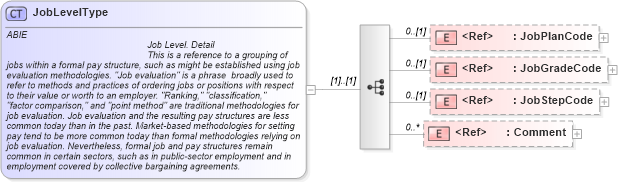
<xsd:complexType name="JobLevelType">
    <xsd:annotation>
        <xsd:documentation source="http://www.hr-xml.org" xml:lang="en">
            <ccts:CategoryCode xmlns:ccts="urn:un:unece:uncefact:documentation:1.1">ABIE</ccts:CategoryCode>
            <ccts:DictionaryEntryName xmlns:ccts="urn:un:unece:uncefact:documentation:1.1">Job Level. Detail</ccts:DictionaryEntryName>
            <ccts:DefinitionText xmlns:ccts="urn:un:unece:uncefact:documentation:1.1">This is a reference to a grouping of jobs within a formal pay structure, such as might be established using job evaluation methodologies. "Job evaluation" is a phrase  broadly used to refer to methods and practices of ordering jobs or positions with respect to their value or worth to an employer. "Ranking," "classification,"
"factor comparison," and "point method" are traditional methodologies for job evaluation. Job evaluation and the resulting pay structures are less common today than in the past. Market-based methodologies for setting pay tend to be more common today than formal methodologies relying on job evaluation. Nevertheless, formal job and pay structures remain common in certain sectors, such as in public-sector employment and in employment covered by collective bargaining agreements.
</ccts:DefinitionText>
        </xsd:documentation>
    </xsd:annotation>
    <xsd:sequence>
        <xsd:element ref="JobPlanCode" minOccurs="0" />
        <xsd:element ref="JobGradeCode" minOccurs="0" />
        <xsd:element ref="JobStepCode" minOccurs="0" />
        <xsd:element ref="Comment" minOccurs="0" maxOccurs="unbounded" />
    </xsd:sequence>
</xsd:complexType>
|
 XSD Schema Diagram: