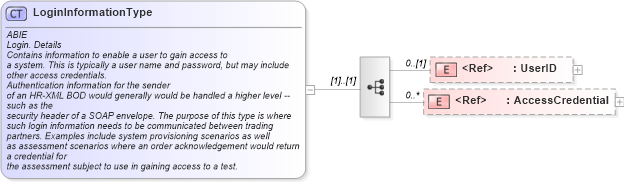
<xsd:complexType name="LoginInformationType">
    <xsd:annotation>
        <xsd:documentation source="http://www.hr-xml.org" xml:lang="en">
            <ccts:CategoryCode xmlns:ccts="urn:un:unece:uncefact:documentation:1.1">ABIE</ccts:CategoryCode>
            <ccts:DictionaryEntryName xmlns:ccts="urn:un:unece:uncefact:documentation:1.1">Login. Details</ccts:DictionaryEntryName>
            <ccts:DefinitionText xmlns:ccts="urn:un:unece:uncefact:documentation:1.1">Contains information to enable a user to gain access to
				a system. This is typically a user name and password, but may include
				other access credentials.</ccts:DefinitionText>
            <ccts:UsageRule xmlns:ccts="urn:un:unece:uncefact:documentation:1.1">Authentication information for the sender
				of an HR-XML BOD would generally would be handled a higher level -- such as the
				security header of a SOAP envelope. The purpose of this type is where
				such login information needs to be communicated between trading
				partners. Examples include system provisioning scenarios as well
				as assessment scenarios where an order acknowledgement would return a credential for
				the assessment subject to use in gaining access to a test.</ccts:UsageRule>
        </xsd:documentation>
    </xsd:annotation>
    <xsd:sequence>
        <xsd:element ref="UserID" minOccurs="0">
            <xsd:annotation>
                <xsd:documentation source="http://www.hr-xml.org" xml:lang="en">A user name or ID.</xsd:documentation>
            </xsd:annotation>
        </xsd:element>
        <xsd:element ref="AccessCredential" minOccurs="0" maxOccurs="unbounded">
            <xsd:annotation>
                <xsd:documentation source="http://www.hr-xml.org" xml:lang="en">
			Contains a password or other token associated with the authentication of
			a user. This component is repeatable to allow for multiple credentials or tokens.
			</xsd:documentation>
            </xsd:annotation>
        </xsd:element>
    </xsd:sequence>
</xsd:complexType>
|
 XSD Schema Diagram: