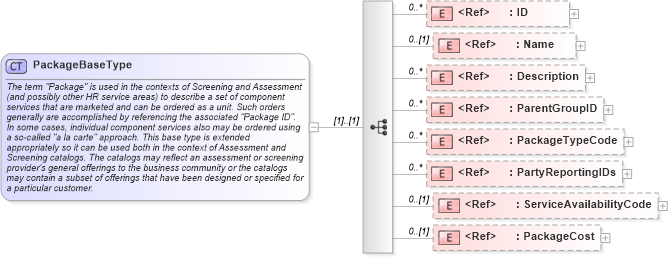
<xsd:complexType name="PackageBaseType">
    <xsd:annotation>
        <xsd:documentation>The term "Package" is used in the contexts of Screening and Assessment (and possibly other HR service areas) to describe a set of component services that are marketed and can be ordered as a unit. Such orders generally are accomplished by referencing the associated "Package ID". In some cases, individual component services also may be ordered using a so-called "a la carte" approach. This base type is extended appropriately so it can be used both in the context of Assessment and Screening catalogs. The catalogs may reflect an assessment or screening provider's general offerings to the business community or the catalogs may contain a subset of offerings that have been designed or specified for a particular customer. </xsd:documentation>
    </xsd:annotation>
    <xsd:sequence>
        <xsd:element ref="ID" minOccurs="0" maxOccurs="unbounded">
            <xsd:annotation>
                <xsd:documentation>This is the "Package ID" that would be used to order a set of screening or assessment services.</xsd:documentation>
            </xsd:annotation>
        </xsd:element>
        <xsd:element ref="oa:Name" minOccurs="0">
            <xsd:annotation>
                <xsd:documentation>The name or terse descriptive label by which the package is referred.</xsd:documentation>
            </xsd:annotation>
        </xsd:element>
        <xsd:element ref="oa:Description" minOccurs="0" maxOccurs="unbounded" />
        <xsd:element ref="ParentGroupID" minOccurs="0" maxOccurs="unbounded">
            <xsd:annotation>
                <xsd:documentation>A reference from a child package to one or more associated parent entity. This is used to express an "is a part of" relationship by reference. This approach is used in a number of places within the HR-XML as an alternative to placement of one entity within the other's hierarchy. The use of the ParentGroupID reference is a more flexible and light-weight alternative to recursive structures and deeply nested hierarchies.</xsd:documentation>
            </xsd:annotation>
        </xsd:element>
        <xsd:element ref="PackageTypeCode" minOccurs="0" maxOccurs="unbounded" />
        <xsd:element ref="PartyReportingIDs" minOccurs="0" maxOccurs="unbounded">
            <xsd:annotation>
                <xsd:documentation>This is a repeating ID set used to pass along identifiers that are used for reporting, filtering, accounting, cost center identification, and similar purposes. In a typical scenario, these might be specified by a customer to a supplier and then reported back by the supplier within collaborations as specified by the Customer.   The agencyRoleCode and schemeAgencyID attributes available on PartyReportingIDs can be used to specify the role (Customer, Requester, Supplier) and identity of the party that controls the ID set. This is intended as a flexible means to associate various reporting IDs with a package. For example, a customer and supplier might agree to use the PartyReportIDGroup as a way to index Packages by the customer's employee or organizational groups with which they are associated or to which they pertain.
Example:
                agencyRoleCode = Customer
                schemeAgencyID = Acme Corp. Inc.
                schemeID = Acme Employee Group ID
                                    ID = HR Manager and Compliance
                                    ID = Hiring Manager
			                        ID = Recruiter
			                        ID = Learning-Knowledge Management
			</xsd:documentation>
            </xsd:annotation>
        </xsd:element>
        <xsd:element ref="ServiceAvailabilityCode" minOccurs="0" />
        <xsd:element ref="PackageCost" minOccurs="0" />
    </xsd:sequence>
</xsd:complexType>
|
 XSD Schema Diagram: