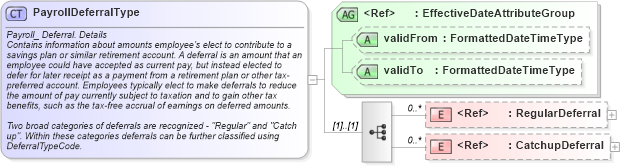
<xsd:complexType name="PayrollDeferralType">
    <xsd:annotation>
        <xsd:documentation source="http://www.hr-xml.org" xml:lang="en">
            <ccts:DictionaryEntryName xmlns:ccts="urn:un:unece:uncefact:documentation:1.1">Payroll_ Deferral. Details</ccts:DictionaryEntryName>
            <ccts:DefinitionText xmlns:ccts="urn:un:unece:uncefact:documentation:1.1">Contains information about amounts employee's elect to contribute to a savings plan or similar retirement account. A deferral is an amount that an employee could have accepted as current pay, but instead elected to defer for later receipt as a payment from a retirement plan or other tax-preferred account. Employees typically elect to make deferrals to reduce the amount of pay currently subject to taxation and to gain other tax benefits, such as the tax-free accrual of earnings on deferred amounts.
</ccts:DefinitionText>
            <ccts:DefinitionUsage xmlns:ccts="urn:un:unece:uncefact:documentation:1.1">Two broad categories of deferrals are recognized - "Regular" and "Catch up". Within these categories deferrals can be further classified using DeferralTypeCode.</ccts:DefinitionUsage>
        </xsd:documentation>
    </xsd:annotation>
    <xsd:sequence>
        <xsd:element ref="RegularDeferral" minOccurs="0" maxOccurs="unbounded" />
        <xsd:element ref="CatchupDeferral" minOccurs="0" maxOccurs="unbounded" />
    </xsd:sequence>
    <xsd:attributeGroup ref="EffectiveDateAttributeGroup" />
</xsd:complexType>
|
 XSD Schema Diagram: