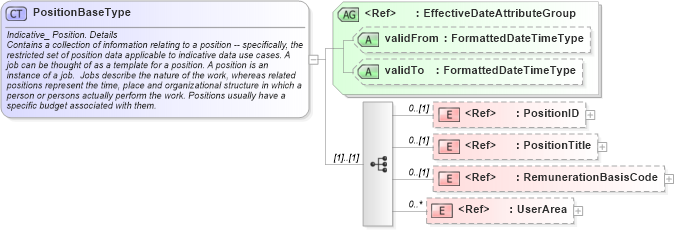
<xsd:complexType name="PositionBaseType">
    <xsd:annotation>
        <xsd:documentation source="http://www.hr-xml.org" xml:lang="en">
            <ccts:DictionaryEntryName xmlns:ccts="urn:un:unece:uncefact:documentation:1.1">Indicative_ Position. Details</ccts:DictionaryEntryName>
            <ccts:DefinitionText xmlns:ccts="urn:un:unece:uncefact:documentation:1.1">Contains a collection of information relating to a position -- specifically, the restricted set of position data applicable to indicative data use cases. A job can be thought of as a template for a position. A position is an instance of a job.  Jobs describe the nature of the work, whereas related positions represent the time, place and organizational structure in which a person or persons actually perform the work. Positions usually have a specific budget associated with them.	</ccts:DefinitionText>
        </xsd:documentation>
    </xsd:annotation>
    <xsd:sequence>
        <xsd:element ref="PositionID" minOccurs="0" />
        <xsd:element ref="PositionTitle" minOccurs="0" />
        <xsd:element ref="RemunerationBasisCode" minOccurs="0">
            <xsd:annotation>
                <xsd:documentation source="http://www.hr-xml.org" xml:lang="en">A code classifying the primary method of payment for the associated position or employment. RemunerationBasisCode is an HR-XML closed list. Values must be support without extension or restriction.</xsd:documentation>
            </xsd:annotation>
        </xsd:element>
        <xsd:element ref="UserArea" minOccurs="0" maxOccurs="unbounded" />
    </xsd:sequence>
    <xsd:attributeGroup ref="EffectiveDateAttributeGroup" />
</xsd:complexType>
|
 XSD Schema Diagram: