Definition Type: ComplexType
Name: ProcessCandidateType
Namespace: http://www.hr-xml.org/3
Type: oa:BusinessObjectDocumentType
Containing Schema: ProcessCandidate.xsd
Abstract
Documentation:
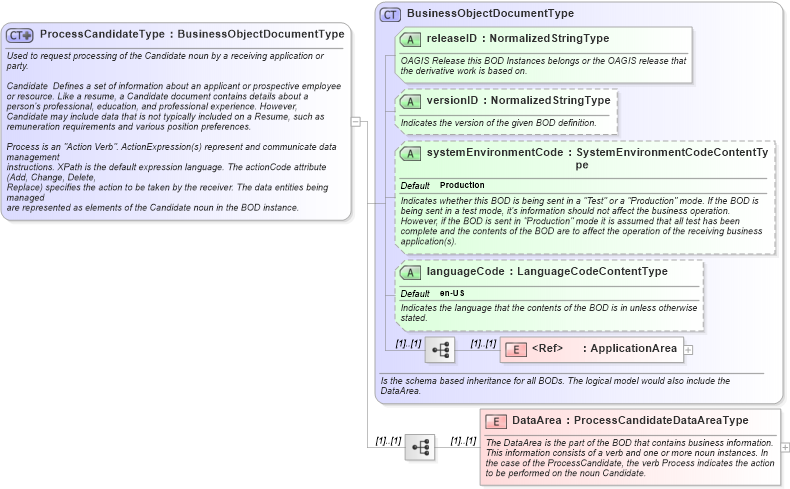
Used to request processing of the Candidate noun by a receiving application or party. Candidate Defines a set of information about an applicant or prospective employee or resource. Like a resume, a Candidate document contains details about a person's professional, education, and professional experience. However, Candidate may include data that is not typically included on a Resume, such as remuneration requirements and various position preferences. Process is an "Action Verb". ActionExpression(s) represent and communicate data management instructions. XPath is the default expression language. The actionCode attribute (Add, Change, Delete, Replace) specifies the action to be taken by the receiver. The data entities being managed are represented as elements of the Candidate noun in the BOD instance.
Collapse XSD Schema Diagram:
Drilldown into DataArea in schema processcandidate_xsd Drilldown into ApplicationArea in schema meta_xsd Drilldown into languageCode in schema meta_xsd Drilldown into systemEnvironmentCode in schema meta_xsd Drilldown into versionID in schema meta_xsd Drilldown into releaseID in schema meta_xsd Drilldown into BusinessObjectDocumentType in schema meta_xsdXSD Diagram of ProcessCandidateType in schema processcandidate_xsd (HR-XML - Human Resources XML)
Collapse XSD Schema Code:
<xsd:complexType name="ProcessCandidateType">
    <xsd:annotation>
        <xsd:documentation> 
       Used to request processing of the Candidate noun by a receiving application or party.  

       Candidate  Defines a set of information about an applicant or prospective employee or resource. Like a resume, a Candidate document contains details about a person's professional, education, and professional experience. However, Candidate may include data that is not typically included on a Resume, such as remuneration requirements and various position preferences. 

       Process is an "Action Verb". ActionExpression(s) represent and communicate data management  
       instructions. XPath is the default expression language. The actionCode attribute (Add, Change, Delete,   
       Replace) specifies the action to be taken by the receiver. The data entities being managed   
       are represented as elements of the Candidate noun in the BOD instance. 
       </xsd:documentation>
    </xsd:annotation>
    <xsd:complexContent>
        <xsd:extension base="oa:BusinessObjectDocumentType">
            <xsd:sequence>
                <xsd:element name="DataArea" type="ProcessCandidateDataAreaType">
                    <xsd:annotation>
                        <xsd:documentation>The DataArea is the part of the BOD that contains business information. This information consists of a verb and one or more noun instances. In the case of the ProcessCandidate, the verb Process indicates the action to be performed on the noun Candidate.</xsd:documentation>
                    </xsd:annotation>
                </xsd:element>
            </xsd:sequence>
        </xsd:extension>
    </xsd:complexContent>
</xsd:complexType>
Collapse Child Elements:
Name Type Min Occurs Max Occurs
ApplicationArea oa:ApplicationArea (1) (1)
DataArea nsA:DataArea (1) (1)
Collapse Child Attributes:
Name Type Default Value Use
releaseID oa:releaseID Required
versionID oa:versionID Optional
systemEnvironmentCode oa:systemEnvironmentCode Production Optional
languageCode oa:languageCode en-US Optional
Collapse Derivation Tree:
Collapse References:
nsA:ProcessCandidate