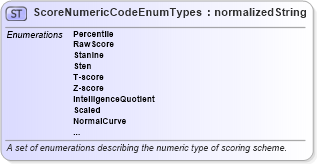
<xsd:simpleType name="ScoreNumericCodeEnumTypes">
    <xsd:annotation>
        <xsd:documentation source="http://www.hr-xml.org" xml:lang="en">
A set of enumerations describing the numeric type of scoring scheme.
       </xsd:documentation>
    </xsd:annotation>
    <xsd:restriction base="xsd:normalizedString">
        <xsd:enumeration value="Percentile">
            <xsd:annotation>
                <xsd:documentation>A value on a scale that indicates the percent of a distribution that is equal to or below it. For example, a score at the 80th percentile is equal to or better than 80 percent of the scores.
</xsd:documentation>
            </xsd:annotation>
        </xsd:enumeration>
        <xsd:enumeration value="RawScore">
            <xsd:annotation>
                <xsd:documentation>A numeric test score before it is transformed. </xsd:documentation>
            </xsd:annotation>
        </xsd:enumeration>
        <xsd:enumeration value="Stanine">
            <xsd:annotation>
                <xsd:documentation>Standard Nine. A test score transformed to an equivalent standard score with values 1 through 9.</xsd:documentation>
            </xsd:annotation>
        </xsd:enumeration>
        <xsd:enumeration value="Sten">
            <xsd:annotation>
                <xsd:documentation>Standard Ten. A test score transformed to an equivalent standard score with values 1 through 10.</xsd:documentation>
            </xsd:annotation>
        </xsd:enumeration>
        <xsd:enumeration value="T-score">
            <xsd:annotation>
                <xsd:documentation>A test score transformed to an equivalent standard score with an average of 50 and standard deviation of 10.</xsd:documentation>
            </xsd:annotation>
        </xsd:enumeration>
        <xsd:enumeration value="Z-score">
            <xsd:annotation>
                <xsd:documentation>A standard score indicates how many standard deviations an observation is above or below the mean.</xsd:documentation>
            </xsd:annotation>
        </xsd:enumeration>
        <xsd:enumeration value="IntelligenceQuotient">
            <xsd:annotation>
                <xsd:documentation>An index of intelligence, with an average IQ of 100 and standard deviation of 15.</xsd:documentation>
            </xsd:annotation>
        </xsd:enumeration>
        <xsd:enumeration value="Scaled">
            <xsd:annotation>
                <xsd:documentation>A transformation of the raw score to a common gradation that can be used for comparison to other forms of the test. </xsd:documentation>
            </xsd:annotation>
        </xsd:enumeration>
        <xsd:enumeration value="NormalCurve">
            <xsd:annotation>
                <xsd:documentation>The score expressed as a percent of cases below this score assuming a normal distribution.</xsd:documentation>
            </xsd:annotation>
        </xsd:enumeration>
        <xsd:enumeration value="GPA">
            <xsd:annotation>
                <xsd:documentation>a measure of a student's academic achievement. Calculated by dividing the total number of grade points received by the total number attempted.</xsd:documentation>
            </xsd:annotation>
        </xsd:enumeration>
    </xsd:restriction>
</xsd:simpleType>
|
 XSD Schema Diagram:
 Facets: