<xsd:simpleType name="ScreeningResultCodeEnumType">
    <xsd:annotation>
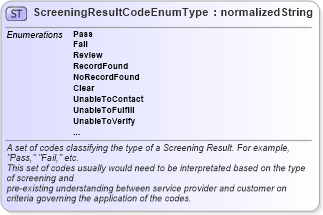
        <xsd:documentation>A set of codes classifying the type of a Screening Result. For example, "Pass," "Fail," etc.
			This set of codes usually would need to be interpretated based on the type of screening and
			pre-existing understanding between service provider and customer on criteria governing the application of the codes.
			</xsd:documentation>
    </xsd:annotation>
    <xsd:restriction base="xsd:normalizedString">
        <xsd:enumeration value="Pass">
            <xsd:annotation>
                <xsd:documentation>Indicates within the boundaries of any pre-existing understanding between screening service provider and customer that no disqualifying information resulted from the screening and/or that qualification requirements were confirmed.</xsd:documentation>
            </xsd:annotation>
        </xsd:enumeration>
        <xsd:enumeration value="Fail">
            <xsd:annotation>
                <xsd:documentation>Indicates within the boundaries of any pre-existing understanding between screening service provider and customer that disqualifying information resulted from the screening and/or that qualification requirements were not satisfied.</xsd:documentation>
            </xsd:annotation>
        </xsd:enumeration>
        <xsd:enumeration value="Review">
            <xsd:annotation>
                <xsd:documentation>Indicates the existence of interim and or final results requiring the customer's review.</xsd:documentation>
            </xsd:annotation>
        </xsd:enumeration>
        <xsd:enumeration value="RecordFound">
            <xsd:annotation>
                <xsd:documentation>Indicates the screening returned one or more record, which may or may not contain disqualifying information. This is a slightly more fine grain communicatione than "Review." In some cases, service providers report having a "Hit," which would be an equivalent. It is assumed that the customer needs to review "hits" to interpret their meaning and significance.</xsd:documentation>
            </xsd:annotation>
        </xsd:enumeration>
        <xsd:enumeration value="NoRecordFound">
            <xsd:annotation>
                <xsd:documentation>Indicates the screening did not return any records.  In some cases, service providers report "No Hits," which would be an equivalent. The customer needs to interpret the meaning and significance based on the type of screening and its
			understanding with the screening provider. On its face, this result type is neither qualifying or disqualifying.</xsd:documentation>
            </xsd:annotation>
        </xsd:enumeration>
        <xsd:enumeration value="Clear">
            <xsd:annotation>
                <xsd:documentation>Indicates the screening did not return any disqualifying results or records. Can be a slightly more fine grain communication than "No Record Found." </xsd:documentation>
            </xsd:annotation>
        </xsd:enumeration>
        <xsd:enumeration value="UnableToContact" />
        <xsd:enumeration value="UnableToFulfill" />
        <xsd:enumeration value="UnableToVerify" />
        <xsd:enumeration value="Positive">
            <xsd:annotation>
                <xsd:documentation>This result type is reserved for alcohol, drug, and similar medical tests. Indicates that the test was "positive." In the context of substance screenings, this communicates that a prohibited substance (or evidence thereof such as "metabolites") were found in quantities exceeding a threshold to be considered a positive result. Such a result usually would have been reviewed by a medical review officer who may have interpreted the test findings together with facts about the search subject's condition (weight, age, prescribed medicine, etc.).</xsd:documentation>
            </xsd:annotation>
        </xsd:enumeration>
        <xsd:enumeration value="Negative">
            <xsd:annotation>
                <xsd:documentation>This result type is reserved for alcohol, drug, and similar medical tests. Indicates that the test was "negative." In the context of substance screenings, this communicates that a prohibited substance (or evidence thereof such as "metabolites") were NOT found in quantities exceeding a threshold to be considered a positive result. Such a result usually would have been reviewed by a medical review officer who may have interpreted the test findings together with facts about the search subject's condition (weight, age, prescribed medicine, etc.).</xsd:documentation>
            </xsd:annotation>
        </xsd:enumeration>
    </xsd:restriction>
</xsd:simpleType>
|
 XSD Schema Diagram:
 Facets: