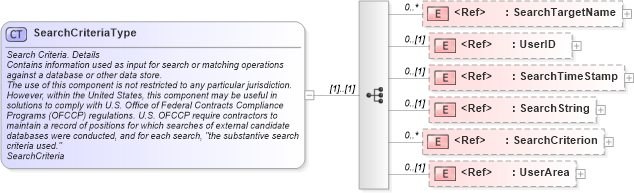
<xsd:complexType name="SearchCriteriaType">
    <xsd:annotation>
        <xsd:documentation source="http://www.hr-xml.org" xml:lang="en">
            <ccts:CategoryCode xmlns:ccts="urn:un:unece:uncefact:documentation:1.1" />
            <ccts:DictionaryEntryName xmlns:ccts="urn:un:unece:uncefact:documentation:1.1">Search Criteria. Details</ccts:DictionaryEntryName>
            <ccts:DefinitionText xmlns:ccts="urn:un:unece:uncefact:documentation:1.1">Contains information used as input for search or matching operations against a database or other data store. </ccts:DefinitionText>
            <ccts:UsageRule xmlns:ccts="urn:un:unece:uncefact:documentation:1.1">The use of this component is not restricted to any particular jurisdiction. However, within the United States, this component may be useful in solutions to comply with U.S. Office of Federal Contracts Compliance Programs (OFCCP) regulations. U.S. OFCCP require contractors to maintain a record of positions for which searches of external candidate databases were conducted, and for each search, "the substantive search criteria used."</ccts:UsageRule>
            <ccts:BusinessTerm xmlns:ccts="urn:un:unece:uncefact:documentation:1.1">SearchCriteria</ccts:BusinessTerm>
        </xsd:documentation>
    </xsd:annotation>
    <xsd:sequence>
        <xsd:element ref="SearchTargetName" minOccurs="0" maxOccurs="unbounded" />
        <xsd:element ref="UserID" minOccurs="0">
            <xsd:annotation>
                <xsd:documentation source="http://www.hr-xml.org" xml:lang="en">An unique identifier distinquishing the user conducting the search. For example, an employee Id for a hiring manager or recruiter. As mentioned above and in accompanying documentation, one use case is compliance with U.S. OFCPP regulations. This is one of the data elements that may be necessary for compliance with those regulations.</xsd:documentation>
            </xsd:annotation>
        </xsd:element>
        <xsd:element ref="SearchTimeStamp" minOccurs="0" />
        <xsd:element ref="SearchString" minOccurs="0" />
        <xsd:element ref="SearchCriterion" minOccurs="0" maxOccurs="unbounded" />
        <xsd:element ref="UserArea" minOccurs="0" />
    </xsd:sequence>
</xsd:complexType>
|
 XSD Schema Diagram: