Definition Type: ComplexType
Name: SyncScreeningCatalogOrderType
Namespace: http://www.hr-xml.org/3
Type: oa:BusinessObjectDocumentType
Containing Schema: SyncScreeningCatalogOrder.xsd
Abstract
Documentation:
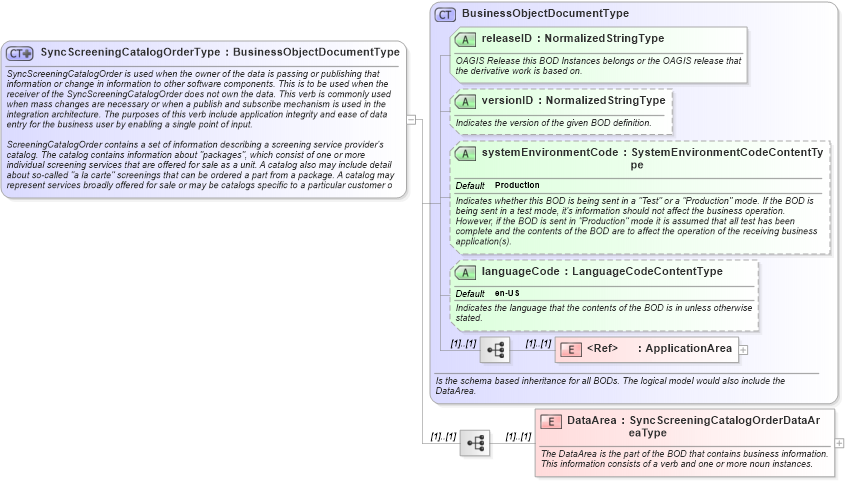
SyncScreeningCatalogOrder is used when the owner of the data is passing or publishing that information or change in information to other software components. This is to be used when the receiver of the SyncScreeningCatalogOrder does not own the data. This verb is commonly used when mass changes are necessary or when a publish and subscribe mechanism is used in the integration architecture. The purposes of this verb include application integrity and ease of data entry for the business user by enabling a single point of input. ScreeningCatalogOrder contains a set of information describing a screening service provider's catalog. The catalog contains information about "packages", which consist of one or more individual screening services that are offered for sale as a unit. A catalog also may include detail about so-called "a la carte" screenings that can be ordered a part from a package. A catalog may represent services broadly offered for sale or may be catalogs specific to a particular customer or organizational unit.
Collapse XSD Schema Diagram:
Drilldown into DataArea in schema syncscreeningcatalogorder_xsd Drilldown into ApplicationArea in schema meta_xsd Drilldown into languageCode in schema meta_xsd Drilldown into systemEnvironmentCode in schema meta_xsd Drilldown into versionID in schema meta_xsd Drilldown into releaseID in schema meta_xsd Drilldown into BusinessObjectDocumentType in schema meta_xsdXSD Diagram of SyncScreeningCatalogOrderType in schema syncscreeningcatalogorder_xsd (HR-XML - Human Resources XML)
Collapse XSD Schema Code:
<xsd:complexType name="SyncScreeningCatalogOrderType">
    <xsd:annotation>
        <xsd:documentation> 
       SyncScreeningCatalogOrder is used when the owner of the data is passing or publishing that information or change in information to other software components. This is to be used when the receiver of the SyncScreeningCatalogOrder does not own the data. This verb is commonly used when mass changes are necessary or when a publish and subscribe mechanism is used in the integration architecture. The purposes of this verb include application integrity and ease of data entry for the business user by enabling a single point of input. 

        ScreeningCatalogOrder contains a set of information describing a screening service provider's catalog. The catalog contains information about "packages", which consist of one or more individual screening services that are offered for sale as a unit. A catalog also may include detail about so-called "a la carte" screenings that can be ordered a part from a package. A catalog may represent services broadly offered for sale or may be catalogs specific to a particular customer or organizational unit. 
       </xsd:documentation>
    </xsd:annotation>
    <xsd:complexContent>
        <xsd:extension base="oa:BusinessObjectDocumentType">
            <xsd:sequence>
                <xsd:element name="DataArea" type="SyncScreeningCatalogOrderDataAreaType">
                    <xsd:annotation>
                        <xsd:documentation>The DataArea is the part of the BOD that contains business information. This information consists of a verb and one or more noun instances.</xsd:documentation>
                    </xsd:annotation>
                </xsd:element>
            </xsd:sequence>
        </xsd:extension>
    </xsd:complexContent>
</xsd:complexType>
Collapse Child Elements:
Name Type Min Occurs Max Occurs
ApplicationArea oa:ApplicationArea (1) (1)
DataArea nsA:DataArea (1) (1)
Collapse Child Attributes:
Name Type Default Value Use
releaseID oa:releaseID Required
versionID oa:versionID Optional
systemEnvironmentCode oa:systemEnvironmentCode Production Optional
languageCode oa:languageCode en-US Optional
Collapse Derivation Tree:
Collapse References:
nsA:SyncScreeningCatalogOrder