Definition Type: Element
Name: cache
Namespace: http://membrane-soa.org/proxies/1/
Type: beans:identifiedType
Containing Schema: proxies-1.xsd
Abstract
Documentation:
<h3><b>Topic:</b></h3> 4. Interceptors/Features<br/><h3><b>Description:</b></h3> <p> Don't use, this does NOT implement valid HTTP caching. </p> <p> We currently just use this class to cache a bunch of Debian and Ubuntu Repositories as well as the Docker Registry for offline use. The cache does not revalidate any responses, so machines querying the cache for Debian package updates will be stuck in the past until the cache (on disk) is cleared manually. - This is - simply put - the only use case, where using this class makes any sense. </p><br/>
Collapse XSD Schema Diagram:
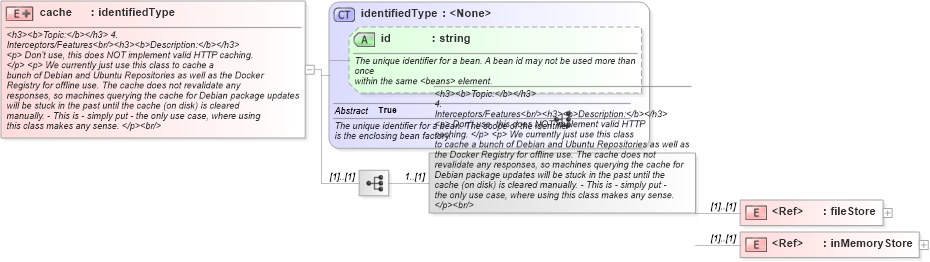
Drilldown into inMemoryStore in schema proxies-1_xsd Drilldown into fileStore in schema proxies-1_xsd Drilldown into id in schema spring-beans-3_1_xsd Drilldown into identifiedType in schema spring-beans-3_1_xsdXSD Diagram of cache in schema proxies-1_xsd (Membrane Service Proxy)
Collapse XSD Schema Code:
<xsd:element name="cache">
    <xsd:annotation>
        <xsd:documentation>&lt;h3&gt;&lt;b&gt;Topic:&lt;/b&gt;&lt;/h3&gt; 4.
                Interceptors/Features&lt;br/&gt;&lt;h3&gt;&lt;b&gt;Description:&lt;/b&gt;&lt;/h3&gt;
                &lt;p&gt; Don't use, this does NOT implement valid HTTP caching.
                &lt;/p&gt; &lt;p&gt; We currently just use this class to cache a
                bunch of Debian and Ubuntu Repositories as well as the Docker
                Registry for offline use. The cache does not revalidate any
                responses, so machines querying the cache for Debian package updates
                will be stuck in the past until the cache (on disk) is cleared
                manually. - This is - simply put - the only use case, where using
                this class makes any sense. &lt;/p&gt;&lt;br/&gt;
            </xsd:documentation>
    </xsd:annotation>
    <xsd:complexType>
        <xsd:complexContent>
            <xsd:extension base="beans:identifiedType">
                <xsd:sequence>
                    <xsd:choice minOccurs="1">
                        <xsd:annotation>
                            <xsd:documentation>&lt;h3&gt;&lt;b&gt;Topic:&lt;/b&gt;&lt;/h3&gt;
                                    4.
                                    Interceptors/Features&lt;br/&gt;&lt;h3&gt;&lt;b&gt;Description:&lt;/b&gt;&lt;/h3&gt;
                                    &lt;p&gt; Don't use, this does NOT implement valid HTTP
                                    caching. &lt;/p&gt; &lt;p&gt; We currently just use this class
                                    to cache a bunch of Debian and Ubuntu Repositories as well as
                                    the Docker Registry for offline use. The cache does not
                                    revalidate any responses, so machines querying the cache for
                                    Debian package updates will be stuck in the past until the
                                    cache (on disk) is cleared manually. - This is - simply put -
                                    the only use case, where using this class makes any sense.
                                    &lt;/p&gt;&lt;br/&gt;</xsd:documentation>
                        </xsd:annotation>
                        <xsd:element ref="fileStore">
                        </xsd:element>
                        <xsd:element ref="inMemoryStore">
                        </xsd:element>
                    </xsd:choice>
                </xsd:sequence>
            </xsd:extension>
        </xsd:complexContent>
    </xsd:complexType>
</xsd:element>
Collapse Child Elements:
Name Type Min Occurs Max Occurs
fileStore nsB:fileStore (1) (1)
inMemoryStore nsB:inMemoryStore (1) (1)
Collapse Child Attributes:
Name Type Default Value Use
id beans:id (Optional)
Collapse Derivation Tree: