Definition Type: ComplexType
Name: AbstractGeneralTransformationType
Namespace: http://niem.gov/niem/external/ogc-gml/3.1.1/dhs-gmo/1.0.0
Type: gml:AbstractCoordinateOperationType
Containing Schema: gml.xsd
Abstract True
Documentation:
An abstract operation on coordinates that usually includes a change of Datum. The parameters of a coordinate transformation are empirically derived from data containing the coordinates of a series of points in both coordinate reference systems. This computational process is usually "over-determined", allowing derivation of error (or accuracy) estimates for the transformation. Also, the stochastic nature of the parameters may result in multiple (different) versions of the same coordinate transformation. This abstract complexType is expected to be extended for well-known operation methods with many Transformation instances, in Application Schemas that define operation-method-specialized value element names and contents. This transformation uses an operation method with associated parameter values. However, operation methods and parameter values are directly associated with concrete subtypes, not with this abstract type. All concrete types derived from this type shall extend this type to include a "usesMethod" element that references one "OperationMethod" element. Similarly, all concrete types derived from this type shall extend this type to include one or more elements each named "uses...Value" that each use the type of an element substitutable for the "_generalParameterValue" element.
Collapse XSD Schema Diagram:
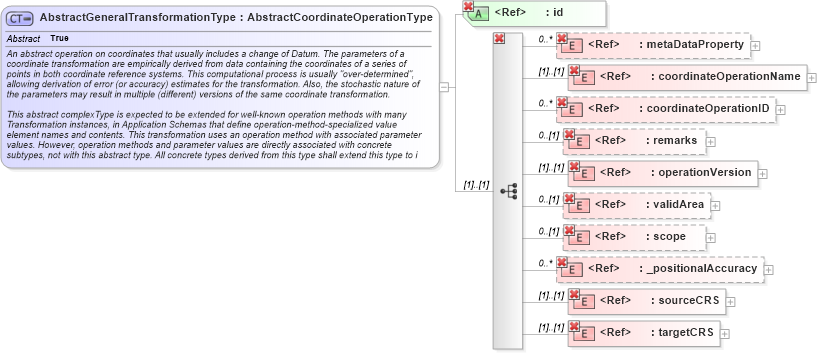
Drilldown into targetCRS in schema gml_xsd Drilldown into sourceCRS in schema gml_xsd Drilldown into _positionalAccuracy in schema gml_xsd Drilldown into scope in schema gml_xsd Drilldown into validArea in schema gml_xsd Drilldown into operationVersion in schema gml_xsd Drilldown into remarks in schema gml_xsd Drilldown into coordinateOperationID in schema gml_xsd Drilldown into coordinateOperationName in schema gml_xsd Drilldown into metaDataProperty in schema gml_xsd Drilldown into id in schema gml_xsdXSD Diagram of AbstractGeneralTransformationType in schema gml_xsd (National Information Exchange Model (NEIM))
Collapse XSD Schema Code:
<complexType name="AbstractGeneralTransformationType" abstract="true">
    <annotation>
        <documentation>An abstract operation on coordinates that usually includes a change of Datum. The parameters of a coordinate transformation are empirically derived from data containing the coordinates of a series of points in both coordinate reference systems. This computational process is usually "over-determined", allowing derivation of error (or accuracy) estimates for the transformation. Also, the stochastic nature of the parameters may result in multiple (different) versions of the same coordinate transformation.

This abstract complexType is expected to be extended for well-known operation methods with many Transformation instances, in Application Schemas that define operation-method-specialized value element names and contents. This transformation uses an operation method with associated parameter values. However, operation methods and parameter values are directly associated with concrete subtypes, not with this abstract type. All concrete types derived from this type shall extend this type to include a "usesMethod" element that references one "OperationMethod" element. Similarly, all concrete types derived from this type shall extend this type to include one or more elements each named "uses...Value" that each use the type of an element substitutable for the "_generalParameterValue" element. </documentation>
    </annotation>
    <complexContent>
        <restriction base="gml:AbstractCoordinateOperationType">
            <sequence>
                <element ref="gml:metaDataProperty" minOccurs="0" maxOccurs="unbounded" />
                <element ref="gml:coordinateOperationName" />
                <element ref="gml:coordinateOperationID" minOccurs="0" maxOccurs="unbounded" />
                <element ref="gml:remarks" minOccurs="0" />
                <element ref="gml:operationVersion" />
                <element ref="gml:validArea" minOccurs="0" />
                <element ref="gml:scope" minOccurs="0" />
                <element ref="gml:_positionalAccuracy" minOccurs="0" maxOccurs="unbounded" />
                <element ref="gml:sourceCRS" />
                <element ref="gml:targetCRS" />
            </sequence>
            <attribute ref="gml:id" use="required" />
        </restriction>
    </complexContent>
</complexType>
Collapse Child Elements:
Name Type Min Occurs Max Occurs
metaDataProperty gml:metaDataProperty 0 unbounded
description gml:description 0 (1)
name gml:name 0 unbounded
metaDataProperty gml:metaDataProperty 0 unbounded
description gml:description 0 (1)
name gml:name (1) unbounded
metaDataProperty gml:metaDataProperty 0 unbounded
coordinateOperationName gml:coordinateOperationName (1) (1)
coordinateOperationID gml:coordinateOperationID 0 unbounded
remarks gml:remarks 0 (1)
operationVersion gml:operationVersion 0 (1)
validArea gml:validArea 0 (1)
scope gml:scope 0 (1)
_positionalAccuracy gml:_positionalAccuracy 0 unbounded
sourceCRS gml:sourceCRS 0 (1)
targetCRS gml:targetCRS 0 (1)
metaDataProperty gml:metaDataProperty 0 unbounded
coordinateOperationName gml:coordinateOperationName (1) (1)
coordinateOperationID gml:coordinateOperationID 0 unbounded
remarks gml:remarks 0 (1)
operationVersion gml:operationVersion (1) (1)
validArea gml:validArea 0 (1)
scope gml:scope 0 (1)
_positionalAccuracy gml:_positionalAccuracy 0 unbounded
sourceCRS gml:sourceCRS (1) (1)
targetCRS gml:targetCRS (1) (1)
<xs:group> gml:StandardObjectProperties (1) (1)
Collapse Child Attributes:
Name Type Default Value Use
id gml:id Required
Collapse Derivation Tree:
Collapse References:
gml:_GeneralTransformationgml:TransformationType,