Definition Type: SimpleType
Name: AddressNumber_type
Namespace: http://niem.gov/niem/external/urisa-street-address/draft-0.2.0/dhs-gmo/1.0.0
Containing Schema: StreetAddressDataStandard.xsd
Documentation:
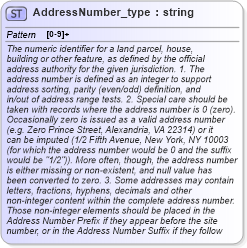
The numeric identifier for a land parcel, house, building or other feature, as defined by the official address authority for the given jurisdiction. 1. The address number is defined as an integer to support address sorting, parity (even/odd) definition, and in/out of address range tests. 2. Special care should be taken with records where the address number is 0 (zero). Occasionally zero is issued as a valid address number (e.g. Zero Prince Street, Alexandria, VA 22314) or it can be imputed (1/2 Fifth Avenue, New York, NY 10003 (for which the address number would be 0 and the suffix would be "1/2")). More often, though, the address number is either missing or non-existent, and null value has been converted to zero. 3. Some addresses may contain letters, fractions, hyphens, decimals and other non-integer content within the complete address number. Those non-integer elements should be placed in the Address Number Prefix if they appear before the site number, or in the Address Number Suffix if they follow the number. 4. The address number must be converted to text when it is combined with the prefix and suffix into a complete address number. 5. If necessary, the Separator can be used to separate the address number from the prefix or suffix elements in constructing the complete address number.
Collapse XSD Schema Diagram:
XSD Diagram of AddressNumber_type in schema streetaddressdatastandard_xsd (National Information Exchange Model (NEIM))
Collapse XSD Schema Code:
<xsd:simpleType name="AddressNumber_type">
    <xsd:annotation>
        <xsd:documentation xml:lang="en">
The numeric identifier for a land parcel, house,
building or other feature, as defined by the official
address authority for the given jurisdiction. 1. The
address number is defined as an integer to support
address sorting, parity (even/odd) definition, and
in/out of address range tests. 2. Special care should be
taken with records where the address number is 0 (zero).
Occasionally zero is issued as a valid address number
(e.g. Zero Prince Street, Alexandria, VA 22314) or it
can be imputed (1/2 Fifth Avenue, New York, NY 10003
(for which the address number would be 0 and the suffix
would be "1/2")). More often, though, the address number
is either missing or non-existent, and null value has
been converted to zero. 3. Some addresses may contain
letters, fractions, hyphens, decimals and other
non-integer content within the complete address number.
Those non-integer elements should be placed in the
Address Number Prefix if they appear before the site
number, or in the Address Number Suffix if they follow
the number. 4. The address number must be converted to
text when it is combined with the prefix and suffix into
a complete address number. 5. If necessary, the
Separator can be used to separate the address number
from the prefix or suffix elements in constructing the
complete address number.
</xsd:documentation>
    </xsd:annotation>
    <xsd:restriction base="xsd:string">
        <xsd:pattern value="[0-9]+" />
    </xsd:restriction>
</xsd:simpleType>
Collapse Facets:
Facet Value
Pattern [0-9]+
Collapse Derivation Tree:
Collapse References:
addr:Number