Definition Type: Element
Name: anchorPoint
Namespace: http://niem.gov/niem/external/ogc-gml/3.1.1/dhs-gmo/1.0.0
Type: gml:CodeType
Containing Schema: gml.xsd
Abstract
Documentation:
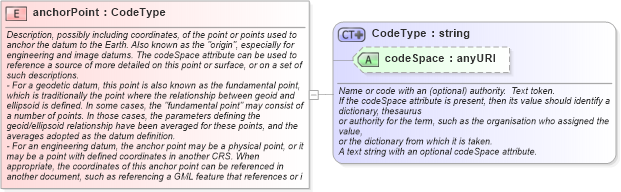
Description, possibly including coordinates, of the point or points used to anchor the datum to the Earth. Also known as the "origin", especially for engineering and image datums. The codeSpace attribute can be used to reference a source of more detailed on this point or surface, or on a set of such descriptions. - For a geodetic datum, this point is also known as the fundamental point, which is traditionally the point where the relationship between geoid and ellipsoid is defined. In some cases, the "fundamental point" may consist of a number of points. In those cases, the parameters defining the geoid/ellipsoid relationship have been averaged for these points, and the averages adopted as the datum definition. - For an engineering datum, the anchor point may be a physical point, or it may be a point with defined coordinates in another CRS. When appropriate, the coordinates of this anchor point can be referenced in another document, such as referencing a GML feature that references or includes a point position. - For an image datum, the anchor point is usually either the centre of the image or the corner of the image. - For a temporal datum, this attribute is not defined. Instead of the anchor point, a temporal datum carries a separate time origin of type DateTime.
Collapse XSD Schema Diagram:
Drilldown into codeSpace in schema gml_xsd Drilldown into CodeType in schema gml_xsdXSD Diagram of anchorPoint in schema gml_xsd (National Information Exchange Model (NEIM))
Collapse XSD Schema Code:
<element name="anchorPoint" type="gml:CodeType">
    <annotation>
        <documentation>Description, possibly including coordinates, of the point or points used to anchor the datum to the Earth. Also known as the "origin", especially for engineering and image datums. The codeSpace attribute can be used to reference a source of more detailed on this point or surface, or on a set of such descriptions. 
- For a geodetic datum, this point is also known as the fundamental point, which is traditionally the point where the relationship between geoid and ellipsoid is defined. In some cases, the "fundamental point" may consist of a number of points. In those cases, the parameters defining the geoid/ellipsoid relationship have been averaged for these points, and the averages adopted as the datum definition.
- For an engineering datum, the anchor point may be a physical point, or it may be a point with defined coordinates in another CRS. When appropriate, the coordinates of this anchor point can be referenced in another document, such as referencing a GML feature that references or includes a point position.
- For an image datum, the anchor point is usually either the centre of the image or the corner of the image.
- For a temporal datum, this attribute is not defined. Instead of the anchor point, a temporal datum carries a separate time origin of type DateTime. </documentation>
    </annotation>
</element>
Collapse Child Attributes:
Name Type Default Value Use
codeSpace gml:codeSpace Optional
Collapse Derivation Tree: