Definition Type: Element
Name: CaseRespondentParty
Namespace: http://niem.gov/niem/domains/jxdm/4.0
Type: nc:EntityType
Containing Schema: jxdm.xsd
Abstract
Documentation:
An entity in a court case that is required to answer a petition for a court order or writ requiring the respondent to take some action, halt an activity or obey a courts direction. In such matters the moving party (the one filing the petition) is usually called the petitioner. Thus, the respondent is equivalent to a defendant in a lawsuit. On an appeal, the party who must respond to an appeal by the losing party in the trial court (called appellant) in the appeals court. The accused in a domestic violence case or civil action; a person responding to a Request or Petition for Protection filed by a petitioner.
Collapse XSD Schema Diagram:
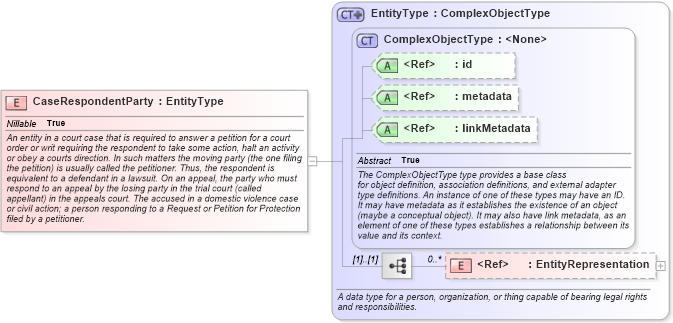
Drilldown into EntityRepresentation in schema niem-core_xsd Drilldown into linkMetadata in schema structures_xsd Drilldown into metadata in schema structures_xsd Drilldown into id in schema structures_xsd Drilldown into ComplexObjectType in schema structures_xsd Drilldown into EntityType in schema niem-core_xsdXSD Diagram of CaseRespondentParty in schema jxdm_xsd (National Information Exchange Model (NEIM))
Collapse XSD Schema Code:
<xsd:element name="CaseRespondentParty" type="nc:EntityType" nillable="true">
    <xsd:annotation>
        <xsd:documentation>An entity in a court case that is required to answer a petition for a court order or writ requiring the respondent to take some action, halt an activity or obey a courts direction. In such matters the moving party (the one filing the petition) is usually called the petitioner. Thus, the respondent is equivalent to a defendant in a lawsuit. On an appeal, the party who must respond to an appeal by the losing party in the trial court (called appellant) in the appeals court. The accused in a domestic violence case or civil action; a person responding to a Request or Petition for Protection filed by a petitioner.</xsd:documentation>
    </xsd:annotation>
</xsd:element>
Collapse Child Elements:
Name Type Min Occurs Max Occurs
EntityRepresentation nc:EntityRepresentation 0 unbounded
Collapse Child Attributes:
Name Type Default Value Use
id s:id (Optional)
metadata s:metadata (Optional)
linkMetadata s:linkMetadata (Optional)
Collapse Derivation Tree: