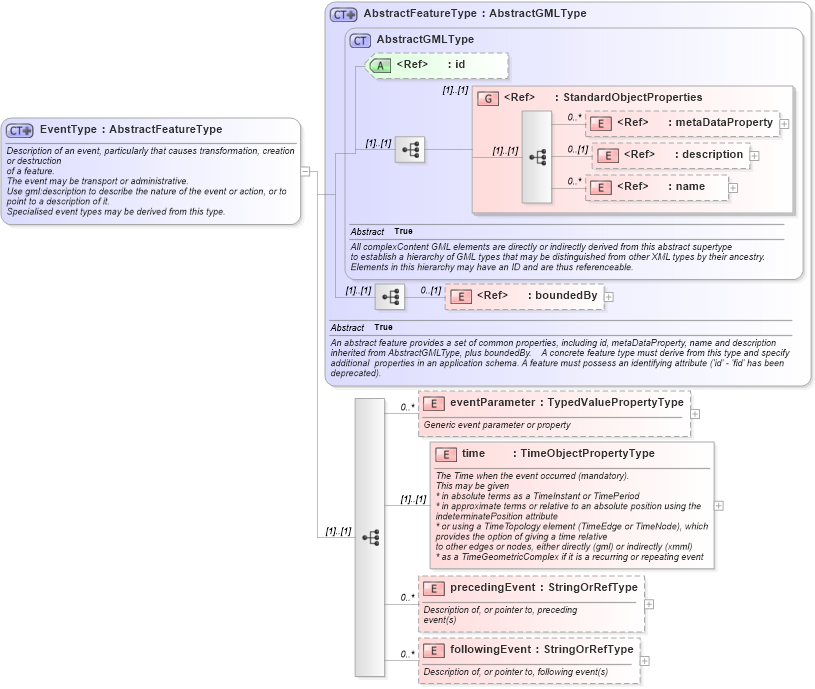
<complexType name="EventType">
    <annotation>
        <documentation>Description of an event, particularly that causes transformation, creation or destruction
of a feature.
The event may be transport or administrative.
Use gml:description to describe the nature of the event or action, or to point to a description of it.
Specialised event types may be derived from this type.</documentation>
    </annotation>
    <complexContent>
        <extension base="gml:AbstractFeatureType">
            <sequence>
                <element name="eventParameter" type="swe:TypedValuePropertyType" minOccurs="0" maxOccurs="unbounded">
                    <annotation>
                        <documentation>Generic event parameter or property</documentation>
                    </annotation>
                </element>
                <element name="time" type="om:TimeObjectPropertyType">
                    <annotation>
                        <documentation>The Time when the event occurred (mandatory).
This may be given
* in absolute terms as a TimeInstant or TimePeriod
* in approximate terms or relative to an absolute position using the indeterminatePosition attribute
* or using a TimeTopology element (TimeEdge or TimeNode), which provides the option of giving a time relative
to other edges or nodes, either directly (gml) or indirectly (xmml)
* as a TimeGeometricComplex if it is a recurring or repeating event</documentation>
                    </annotation>
                </element>
                <element name="precedingEvent" type="gml:StringOrRefType" minOccurs="0" maxOccurs="unbounded">
                    <annotation>
                        <documentation>Description of, or pointer to, preceding
event(s)</documentation>
                    </annotation>
                </element>
                <element name="followingEvent" type="gml:StringOrRefType" minOccurs="0" maxOccurs="unbounded">
                    <annotation>
                        <documentation>Description of, or pointer to, following event(s)</documentation>
                    </annotation>
                </element>
            </sequence>
        </extension>
    </complexContent>
</complexType>
|
 XSD Schema Diagram: