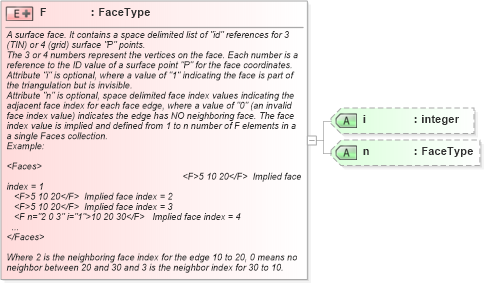
<xs:element name="F">
    <xs:annotation>
        <xs:documentation>A surface face. It contains a space delimited list of "id" references for 3 (TIN) or 4 (grid) surface "P" points. </xs:documentation>
        <xs:documentation>The 3 or 4 numbers represent the vertices on the face. Each number is a reference to the ID value of a surface point "P" for the face coordinates.</xs:documentation>
        <xs:documentation>
Attribute "i" is optional, where a value of "1" indicating the face is part of the triangulation but is invisible.
Attribute "n" is optional, space delimited face index values indicating the adjacent face index for each face edge, where a value of "0" (an invalid face index value) indicates the edge has NO neighboring face. The face index value is implied and defined from 1 to n number of F elements in a a single Faces collection.
Example:
<!--
<Faces>
					<F>5 10 20</F>  Implied face index = 1
   <F>5 10 20</F>  Implied face index = 2
   <F>5 10 20</F>  Implied face index = 3
   <F n="2 0 3" i="1">10 20 30</F>   Implied face index = 4
  ...
</Faces>
-->
Where 2 is the neighboring face index for the edge 10 to 20, 0 means no
neighbor between 20 and 30 and 3 is the neighbor index for 30 to 10.
</xs:documentation>
    </xs:annotation>
    <xs:complexType mixed="true">
        <xs:simpleContent>
            <xs:extension base="FaceType">
                <xs:attribute name="i" type="xs:integer" use="optional" />
                <xs:attribute name="n" type="FaceType" use="optional" />
            </xs:extension>
        </xs:simpleContent>
    </xs:complexType>
</xs:element>
|
 XSD Schema Diagram: